 |
| THE MISTERY OF THE ROYAL ARCH WORD O MISTÉRIO DA PALAVRA Arco Real | |
| by Arturo de Hoyos, 33° por Arturo de Hoyos, 33 ° |
| Published in Vol.2, Year 1993 Publicado em Vol.2, Ano 1993 |
| © No part of this paper may be reproduced without written permission from the Scottish Rite Research Society. |
This precious treasure, long concealed, Este precioso tesouro, muito escondido,
Was by three worthy knights revealed, Esteve por três cavaleiros dignos revelado,
Where erst a temple stood. Onde um templo erigido estava.
Its ancient ruins they explored, Suas ruínas foram exploradas,
And found the Grand Mysterious Word E encontrou a Palavra Grande Misterio
Made known before the flood. [1] Dado a conhecer antes do dilúvio. [1]
This article is based upon a general familiarity with some form of the Royal Arch ritual. Este artigo é baseado em uma familiaridade geral com algum tipo de ritual do Arco Real. It is not a study of the present-day "Royal Arch Word" nor of its symbolism; rather, it offers one possible source for the trilingual compound word associated with the triangle. Não é um estudo sobre a atual "Palavra do Arco Real", nem de seu simbolismo, mas sim oferece uma possível fonte para a palavra composta trilingue associado com o triângulo. For the purposes of this article, irrespective of the rite in which it occurs, this is denominated the "Compound Word." Para os fins deste artigo, independentemente do rito em que ela ocorre, esta é denominada de "palavra composta".
The Ineffable and Sublime Tradition A Tradição Inefável e Sublime
Royal Arch Masonry occupies a unique and perhaps enviable position within the Masonic superstructure. Maçonaria do Real Arco ocupa uma posição única e invejável, talvez, dentro da superestrutura maçônica. Existing under a variety of forms it is present in several Masonic systems. Existente de acordo com uma variedade de formas, está presente em vários sistemas maçônicos. Under the British Constitution as well as in the American York Rite, it is considered the "completion" of the Craft ritual, while in the Ancient and Accepted Scottish Rite (A.&A.SR) its "secrets" are fundamental to the Lodge of Perfection. [2] Segundo a Constituição britânica, assim como na América do Rito de York, é considerada a "conclusão" do ritual Artesanato, enquanto no Rito Escocês Antigo e Aceito (A. & A.SR) os seus "segredos" são fundamentais para a Loja de Perfeição. [2]
A version of the Royal Arch degree likely arose between 1737 and 1740. Uma versão do grau do Arco Real provavelmente surgiu entre 1737 e 1740. Although an investigation of the origins of the degree is beyond the scope of this work, it should be noted that all forms of the rituals likely derive from a common ancestor. [3] The Royal Arch is sometimes denominated "ineffable" and "sublime" in our rituals because it concerns the nature of the Hebrew shem hameforash , or unspoken name of God. Apesar de uma investigação das origens do grau está fora do escopo deste trabalho, deve-se notar que todas as formas dos rituais provavelmente derivam de um ancestral comum. [3] O Real Arco é por vezes denominado "inefável" e "sublime" em nossos rituais, pois diz respeito à natureza do hebraico shem hameforash, ou o nome de Deus não ditas. This name was regarded as so sacred that the ancient Jews would not pronounce it, but substituted the word adonai , "Lord." [4] Esse nome era considerado tão sagrado que os antigos judeus não pronunciá-lo, mas substituiu a palavra Adonai, "Senhor". [4]
Jurisdictional Variations Variações Jurisdicionais
In spite of jurisdictional variations in the rituals, such as the dramatis personae and the alleged historical setting, the core of the ceremony (the discovery of the name of God) is the unifying underlying theme in all versions. [5] The discovery of this sacred name is based on a legend which antedates Speculative Freemasonry by at least 1200 years and embodies traditions common to both early Christian and Qabalistic writings. Apesar das variações jurisdicionais nos rituais, como as personagens eo cenário alegada histórico, o núcleo da cerimônia (a descoberta do nome de Deus) é o tema unificador subjacente em todas as versões. [5] A descoberta deste nome sagrado é baseado em uma lenda que antecede a Maçonaria especulativa por pelo menos 1200 anos e incorpora tradições comuns a ambos os escritos cristãos primitivos e cabalístico.
The Scottish Rite Journal is published bimonthly by the Supreme Council, 33°, Ancient and Accepted Scottish Rite of Freemasonry of the Southern Jurisdiction, United States of America, Washington, DC. O Scottish Rite Journal é publicado bimestralmente pelo Conselho Supremo, 33 º, Antigo e Aceito Rito Escocês da Maçonaria da Jurisdição do Sul, Estados Unidos da América, Washington, DC. |
An Early Masonic Version of the Legend Uma versão Maçônica da Lenda
The Scottish Rite inherited its version of this degree from Steven Morin's 25‑degree Rite which is fortunately preserved in toto in the 1783 Francken Manuscript , now owned by the Supreme Council 33°, Northern Masonic Jurisdicion. [6] O Rito Escocês herdou a sua versão deste grau de Rito Steven Morin grau-25 que é, felizmente preservada em toto no Manuscrito Francken 1783, agora de propriedade do Supremo Conselho 33 °, do Norte Jurisdicion maçônica. [6]
According to the this version of this legend, Enoch sought revelation to learn the Almighty's true name, after which he beheld a triangular golden plate in a vision. Segundo a versão desta desta lenda, Enoque buscou revelação para saber o verdadeiro nome do Todo-Poderoso, depois que ele viu uma placa triangular de ouro em uma visão. Upon the plate was inscribed the Tetragrammaton, YHWH, or sacred four‑letter name of God, which he was forbidden to pronounce. Com a placa foi inscrito o Tetragrammaton, YHVH, ou sagrado nome de quatro letras de Deus, que ele foi proibido de se pronunciar. Presently he seemed to be lowered perpendicularly into the earth through nine arches into a vault where he again beheld the same plate. Atualmente, ele parecia ser baixado perpendicularmente sobre a terra através de nove arcos em um cofre onde ele viu novamente a mesma placa. In commemoration of the vision he subsequently constructed a subterranean temple at the location of its manifestation, and duplicated the plate encrusting it with agate. Em comemoração a visão que ele posteriormente construído um templo subterrâneo no local de sua manifestação, e repetia o prato incrustantes com ágata. The plate was set atop a marble pedestal and deposited in the ninth arch. A placa foi definido em cima de um pedestal de mármore e depositado no arco nona. Enoch was then commanded by God to place a stone door, in which a iron ring had been set, over the first arch to permit entry, and also to protect the treasure from the impending deluge. Enoque foi, em seguida, comandado por Deus para colocar uma porta de pedra, em que um anel de ferro tinha sido definida, sobre o arco primeiro para permitir a entrada, e também para proteger o tesouro do dilúvio iminente. Enoch also constructed two pillars, one of brass, the other of brick, and upon them inscribed the arts and sciences to preserve this knowledge for the world. Enoque também construiu dois pilares, uma de bronze, a outras de tijolo, e sobre eles inscritas as artes e ciências para preservar esse conhecimento para o mundo. The location and knowledge of Enoch's temple was lost following the flood. A localização e conhecimento do templo de Enoque foi perdido após a inundação.
King Solomon coincidentally selected the same site for his temple and upon beginning construction discovered the ruins and a variety of treasures. Rei Salomão coincidentemente seleccionado o mesmo site para o seu templo e sobre a construção início descobriram as ruínas e uma variedade de tesouros. Fearing that the antediluvian structure had been dedicated to a "false god" Solomon changed the temple's planned location. Temendo que a estrutura antediluviano tinha sido dedicada a um "deus falso" Salomão mudou localização prevista do templo. King Solomon also constructed a secret vault beneath the Sanctum Sanctorum which was supported by a large pillar denominated the Pillar of Beauty as it was destined to support the Ark of the Covenant. O rei Salomão construiu também um cofre secreto debaixo do Sanctum Sanctorum que foi apoiado por um grande pilar expressa a Coluna de Beleza como ele estava destinado a apoiar a Arca da Aliança.
Some time later he sent three Craftsmen to search the ruins for more treasures, at which time they discovered the stone door with the iron ring. Algum tempo depois, ele enviou três artesãos para procurar as ruínas de tesouros mais, momento em que descobriram a porta de pedra com o anel de ferro. One of the three tied a rope about his waist and was thrice lowered into the vault when, upon penetrating the ninth arch, he beheld Enoch's gold plate which greatly astonished him. Um dos três amarrou uma corda na cintura e foi três vezes abaixado no cofre, quando, ao penetrar no arco nono, ele viu placa de Enoque ouro que muito o surpreendeu. After informing his companions of the discovery the three entered the vault by means of a rope ladder and retrieved the treasure which they presented to King Solomon who then created them Knights of the Royal Arch. Depois de informar seus companheiros da descoberta os três entraram no cofre por meio de uma escada de corda e recuperou o tesouro que eles apresentaram ao rei Salomão que, em seguida, criou Cavaleiros do Real Arco. Solomon informed them that in time they should be made acquainted with the true pronunciation of the Divine name, and permitted them to enter his secret vault where they encrusted the golden plate upon the Pillar of Beauty. Salomão informou que no momento em que deve ser feita familiarizados com a verdadeira pronúncia do nome divino, e lhes permitiu entrar em seu cofre secreto, onde a lâmina de ouro incrustado no Pilar da Beleza. The name of the chamber was then changed from the secret to the sacred vault. O nome da câmara foi então alterado de o segredo do cofre sagrado.
Judaeo-Christian Sources and Possible Origins Judaico-cristãs Fontes e possíveis origens
Three versions of the legend can be found that pre‑date Speculative Freemasonry. Três versões da lenda pode ser encontrado que a Maçonaria especulativa pré-data. A Fourth‑century version is recorded in a work by Philostorgius, the Arian church historian, while a late thirteenth‑century variation was recorded in the Ecclesiastical History of Nicephorus Callistus, the Greek historian. [7] Masonic scholar Bernard E. Jones, in his Freemasons Book of the Royal Arch , identifies another version based on Callistus and contained in Samuel Lee's Orbis Miraculum , published in 1659. A quarta versão do século é gravado em um trabalho de Philostorgius, o historiador da igreja ariana, enquanto uma variação final do século XIII foi registrado na História Eclesiástica de Nicéforo Calisto, o historiador grego. [7] estudioso maçônico Bernard E. Jones, em seu Livro de Maçons do Real Arco, identifica uma outra versão com base em Calisto e contidas no Orbis Samuel Lee Miraculum, publicado em 1659. A portion of Lee's version follows. Uma porção da versão de Lee segue.
When the foundations [of the Temple at Jerusalem] were a laying, as I have said, there was a stone among the rest, to which the bottom of the foundation was fastened, that slipt from its place, and discovered the mouth of a cave which had been cut in rock. Quando os fundamentos [do Templo em Jerusalém] eram uma imposição, como eu disse, havia uma pedra entre os demais, para que a parte inferior da fundação foi preso, que slipt do seu lugar, e descobriu a boca de uma caverna que tinha sido cortada na rocha. Now when they could not see the bottom by reason of its depth; the Overseers of the building being desirous to have a certain knowledge of the [ sic ] they tied a long rope to one of the Labourers, and let him down: He being come to the bottom, found water in it, that took him up to the mid‑ancles, and searching every part of that hollow place, he found it to be four square, as far as he could conjecture by feeling. Agora, quando eles não podiam ver o fundo em razão de sua profundidade, os Supervisores do edifício estar desejoso de ter um certo conhecimento da [sic] que eles amarraram uma corda longa a um dos Operários, e deixá-lo para baixo: ele vem sendo ao fundo, encontrou água no mesmo, que o levou até os meados ancles, e busca a cada parte desse lugar oco, ele achou ser de quatro quadrados, na medida em que ele poderia conjecturar pelo sentimento. Then returning toward the mouth of it, found a book lying there wrapped up in a piece of thin and clean linnen. Então, retornando em direção à boca dele, encontrei um livro deitado ali embrulhado em um pedaço de linho fino e limpo. Having taken it into his hands, he signified by the rope that they should draw him up. Tendo tomado em suas mãos, ele representado pela corda que deveriam desenhar-lo. When he was pulled up he shews the book, which struck them with admiration, especially seeming so fresh and untoucht as it did, being found in so dark and obscure a hole. Quando ele foi puxado para cima ele shews o livro, que os feriu com admiração, especialmente parecer tão fresca e untoucht como o fez, sendo encontrado em tão obscuro e um buraco. The Book being unfolded, did amaze not only the Jews, but the Grecians also, holding forth even at the beginning of it in great Letters ( In the beginning was the Word, and the Word was with God, and the Word was God .) To speak plainly, that Scripture did manifestly contain the whole gospel.... [8] O livro a ser descoberto, se surpreender não só os judeus, mas os gregos também, retendo ainda no início dela em letras grandes (No princípio era o Verbo, eo Verbo estava com Deus, eo Verbo era Deus.) Para falar claramente, que a Escritura foi manifestamente conter todo o evangelho .... [8]
Jones remarks that Lee's work "give[s] the impression that the framers of the early Royal Arch ... drew inspiration not only from its text but from its frontispiece." Jones comenta que o trabalho de Lee "dar [s] a impressão de que os autores do início do Real Arco ... buscou inspiração não apenas do seu texto, mas a partir do seu frontispício." The frontispiece includes a depiction of a king clothed in royal robes, crowned and bearing a scepter opposite a Jewish High Priest in ceremonial garments, wearing the ephod and breastplate. O frontispício inclui uma representação de um rei vestido com vestes reais, tendo coroado e um cetro em frente a um sumo sacerdote judeu em vestes cerimoniais, vestindo o efod eo peitoral.
Although the versions of the legend mentioned by Lee, Philostorgius and Callistus make no mention of Enoch's vision, the gold plate, the pillars or Solomon, the Sanctum Sanctorum , etc., these were perhaps inspired by other traditions. Embora as versões da lenda mencionado por Lee, Philostorgius e Calisto não fazem menção da visão de Enoque, a placa de ouro, os pilares ou Salomão, o Sanctum Sanctorum, etc, estes foram talvez inspirado por outras tradições. The pseudepigraphal Book of Enoch , for example, includes a series of "dream‑visions" in which the prophet beheld the cornerstone of the earth and the vaults and pillars of heaven. [9] One verse, suggestive of the Royal Arch tradition, reads "Come to me, Enoch, and to my holy Word." [10] O Livro de Enoque pseudoepígrafos, por exemplo, inclui uma série de "sonho" de visões em que o profeta via a pedra angular da Terra e as abóbadas e pilares do céu. [9] Um verso, sugestiva da tradição do Arco Real, lê "Vinde a mim, Enoque, e à minha santa palavra." [10]
The writings of Flavius Josephus may also have contributed to the Masonic tradition. [11] In his Antiquities of the Jews (Book I, Chap. II, vs. 3), he mentions that Seth, the son of Adam "made two pillars; the one of brick, the other of stone: they inscribed their discoveries on them both, that in case the pillar of brick should be destroyed by the flood, the pillar of stone might remain, and exhibit those discoveries to mankind; and also to inform them that there was another pillar of brick erected by them." [12] According to Rabbi Aryeh Kaplan, a Qabalistic legend maintained that Os escritos de Flávio Josefo também pode ter contribuído para a tradição maçônica. [11] Em seu Antiguidades dos Judeus (Livro I, Cap. II, vs 3.), ele menciona que Seth, o filho de Adão "feito dois pilares; o de tijolo, o outro de pedra: eles inscreveram suas descobertas sobre os dois, que no caso do pilar de tijolo deve ser destruído pela inundação, o pilar de pedra pode permanecer, e exibem essas descobertas para a humanidade, e também para informar eles que não foi outro pilar de tijolo erguido por eles ". [12] Segundo o rabino Aryeh Kaplan, uma lenda cabalística afirmava que
when King Solomon built the Temple, he constructed a deep labyrinth under the Temple Mount, where the holy vessels could be hidden in time of danger. quando o rei Salomão construiu o templo, ele construiu um labirinto de profundidade sob o Monte do Templo, onde os vasos sagrados poderiam estar escondidos em tempo de perigo. Foreseeing that Jerusalem would be threatened, King Josiah ordered that the Ark be concealed in this labyrinth, sealing it off so that it would not be discovered by the enemy. Prevendo que Jerusalém seria ameaçado, o rei Josias ordenou que a Arca ser escondido neste labirinto, isolando-a de modo que não seriam descobertos pelo inimigo. Thus, even to this day, the Ark is hidden somewhere under the Temple Mount in Jerusalem. [13] Assim, até hoje, a Arca está escondida em algum lugar sob o Monte do Templo em Jerusalém. [13]
Kaplan also notes, "It is debated if it [the Ark of the Covenant] was hidden under the Holy of Holies or in the Chamber of the Woodshed." [14] Kaplan também observa: "É debatido se ela [Arca da Aliança] foi escondido debaixo do Santo dos Santos ou na Câmara do Woodshed". [14]
In a Masonic legend remarkably similar to that referred to by Rabbi Kaplan, the Select Master's degree explains that some time before the completion of the Temple, Solomon King of Israel, Hiram King of Tyre, and Hiram Abif determined to make an effort to preserve the temple treasures should some calamity befall Israel. Em uma lenda maçônica notavelmente semelhante ao referido pelo Rabino Kaplan, o grau de Mestre Escolhido explica que algum tempo antes da conclusão do Templo, Salomão, rei de Israel, Hiram rei de Tiro, e Hiram Abif determinado a fazer um esforço para preservar a tesouros do templo deve alguma calamidade Israel. With a view to that end they constructed a secret vault under the Temple and placed replicas of the treasures therein–-including an "imitation" Ark of the Covenant. [15] Com vista a esse fim, eles construíram um cofre secreto sob o templo e colocado réplicas dos tesouros nele contidas -. Incluindo uma "imitação" Arca da Aliança [15]
A possible Masonic amalgam is apparent when we recall that in American York Rite rituals the Ark of the Covenant is discovered together with the Book of the Law . Um amálgama possível maçônica é evidente quando lembramos que na América do Rito de York rituais da Arca da Aliança é descoberta, juntamente com o Livro da Lei. Concerning contemporary English Royal Arch rituals, the Rev. F. de Castells writes, Quanto inglês contemporâneo rituais do Arco Real, o Rev. F. de Castells escreve,
The RA Masons of to‑day assure us that when the Sojourners found 'the Pedestal' in the Vault there was on the top a plate of gold. A RA de maçons a-dia garantem-nos que quando os Sojourners encontrado 'o Pedestal' no Vault havia na placa de um top de ouro. This is indeed very significant, because the plate of gold was a sort of cover for the Ark of the Covenant; and therefore although the Ark is not mentioned in the RA Ritual in this connection, the statement implies that the Ark was there all the time under the plate of gold. [16] Isso é realmente muito significativo, pois a lâmina de ouro era uma espécie de capa para a Arca da Aliança e, por isso, embora a Arca não é mencionado no Ritual RA, neste contexto, a declaração implica que a Arca estava lá o tempo todo sob a placa de ouro. [16]
It appears then, that the American York Rite's Royal Arch ritual retains the Ark of the Covenant legend, while the English version, like the Scottish Rite, retains the gold plate. Parece então, que a Royal americano do Rito de York do ritual Arch mantém a Arca da Aliança lenda, enquanto a versão em Inglês, como o Rito Escocês, mantém a placa de ouro.
Genesis vs. St. John Genesis vs St. John
The Scottish Rite rituals make no use of the scroll mentioned by Philostorgius, Callistus and Lee. Os rituais do Rito Escocês não fazem uso do rolo mencionado por Philostorgius, Calisto e Lee. In American York Rite rituals, however, the Book of the Law (Torah), which corresponds with the scroll, is discovered within the coffer and effects an impending anachronism. Em rituais American rito York, no entanto, o Livro da Lei (Torá), que corresponde com o livro, é descoberto dentro do cofre e os efeitos um anacronismo iminente. In the state of Texas, following an examination of the Ark's contents, the Captain of the Host remarks, "Most Excellent [High Priest], there are some characters upon the top of the box." No estado do Texas, após um exame do conteúdo da Arca, o capitão o anfitrião comenta, "Most Excellent [Sumo Sacerdote], existem alguns personagens sobre a parte superior da caixa." The High Priest responds, "You will place the cover on the box, Companion Captain of the Host." O Sumo Sacerdote responde: "Você vai colocar a tampa na caixa de Capitão Companion, da Hóstia". Immediately thereafter, the ritual directs the High Priest to read John 1:1. [17] How can the first line of the Gospel of John, a Christian text, dated ca. Imediatamente depois, o ritual dirige o Sumo Sacerdote para ler João 1:1. [17] Como a primeira linha do Evangelho de João, um texto cristão, de ca. 98 CE, reasonably be read from the Torah 98 EC, ser razoavelmente ler a Torá centuries before the Christian era? séculos antes da era cristã? Should it be employed, even ritualistically, in an Old Testament context? [18] If this is a carry‑over from the Philostorgius, Callistus, or Lee legends it is understandable but is quite improper. Deve ser empregada, mesmo ritual, em um contexto do Antigo Testamento? [18] Se este é um carry-over do Philostorgius lendas, Calisto, ou Lee é compreensível, mas é bastante inadequado. Awareness of this problem may have resulted in the substitution of Genesis 1:1 in many jurisdictions. [19] An alternative explanation for the Genesis reading in post‑1836 rituals involves Godfrey Higgins' citation of the Callistus legend in his Anacalypsis . [20] Higgins merely states that the scroll read, "In the beginning, &c," which obviously fits both passages. Sensibilização para este problema pode ter resultado na substituição de Gênesis 1:1 em muitas jurisdições. [19] Uma explicação alternativa para a leitura Gênesis no pós-1836 envolve rituais citação Godfrey Higgins 'da lenda de Calisto em seu Anacalypsis. [20] Higgins, apenas, que o livro dizia: "No início, & c", que obviamente se encaixa ambas as passagens. Ritualists familiar with Anacalypsis could have assumed that the Genesis citation was intended. Ritualistas familiarizados com Anacalypsis poderia ter assumido que a citação Genesis foi destinada.
The Triangle and the Compound Word O Triângulo ea palavra composta
![clip_image006[4]](https://blogger.googleusercontent.com/img/b/R29vZ2xl/AVvXsEijWGetgdEuCOwnQNSGbCG-tH5S_l1NLkDcsBda-50Cz6bP_MCMcg7ArbJUzXLnsbbg5-QlUcB0YiLNlcCCz12IrbN-_xrNHP-iQALlu-z7Kbg1quc_Gx_1ArQpQPWJi_B3s6O9jybCO8Ls/?imgmax=800 "clip_image006[4]") The Scottish Rite's triangle legend is fairly simple: the Tetragrammaton, vuvh, or alternately its initial letter yod , is engraved on a golden plate discovered atop "a triangular pedestal." [21] In the American York Rite, however, the "imitation" Ark of the Covenant frequently rests on a pedestal, while the triangle appears on the lid of the Ark, and within the triangle are three words in cipher. [22] Depending on jurisdiction, these cipher‑words (the Compound Word) are supposed to have been the word, or key to the word of a Master Mason, lost at the death of Hiram Abif. [23] The Royal Arch cipher used in the United States is actually a variation of a Hebrew Qabalistic cipher known as aiq beker or "the Qabalah of Nine Chambers." [24] Interestingly, both the American York and Scottish Rites preserve the triangle and yod , tradition in another, yet similar, manner. A lenda do Rito Escocês do triângulo é bastante simples: o Tetragrammaton, vuvh, ou alternativamente a sua letra yod inicial, é gravada em uma placa de ouro descoberto em cima de "um pedestal triangular". [21] Na América do Rito de York, no entanto, a "imitação" Arca da Aliança freqüentemente repousa sobre um pedestal, enquanto o triângulo aparece na tampa da Arca, e dentro do triângulo são três palavras em cifra. [22] Dependendo da jurisdição, estas palavras cifra (a palavra composta) devem ter sido a palavra, ou a chave para a palavra de um Mestre Maçom, perdeu com a morte de Hiram Abif. [23] A cifra do Real Arco usado nos Estados Unidos é na verdade uma variação de uma cifra cabalística hebraica conhecida como AIQ beker ou " Qabalah das Nove Câmaras ". [24] Curiosamente, tanto o New York americana e Ritos escoceses preservar o triângulo e yod, a tradição em outro, mas forma, semelhante. The ring worn by Scottish Rite 14° members bears a triangle with a yod in the center, as does the American York Rite's Royal Arch "signet of truth," or "signet of Zerubbabel." O anel usado por Scottish Rite 14 ° membros tem um triângulo com um yod no centro, assim como o Real da América do Rito de York do Arch "sinete da verdade", ou "selo de Zorobabel." Figure 1 depicts the triangle appearing on the ark used in my own Royal Arch Chapter. A Figura 1 mostra o triângulo que aparece na arca usada no meu próprio Capítulo do Real Arco. In the center of the triangle will be found the Tetragrammaton. No centro do triângulo será encontrado Tetragrammaton. The Scottish Rite's triangle legend is fairly simple: the Tetragrammaton, vuvh, or alternately its initial letter yod , is engraved on a golden plate discovered atop "a triangular pedestal." [21] In the American York Rite, however, the "imitation" Ark of the Covenant frequently rests on a pedestal, while the triangle appears on the lid of the Ark, and within the triangle are three words in cipher. [22] Depending on jurisdiction, these cipher‑words (the Compound Word) are supposed to have been the word, or key to the word of a Master Mason, lost at the death of Hiram Abif. [23] The Royal Arch cipher used in the United States is actually a variation of a Hebrew Qabalistic cipher known as aiq beker or "the Qabalah of Nine Chambers." [24] Interestingly, both the American York and Scottish Rites preserve the triangle and yod , tradition in another, yet similar, manner. A lenda do Rito Escocês do triângulo é bastante simples: o Tetragrammaton, vuvh, ou alternativamente a sua letra yod inicial, é gravada em uma placa de ouro descoberto em cima de "um pedestal triangular". [21] Na América do Rito de York, no entanto, a "imitação" Arca da Aliança freqüentemente repousa sobre um pedestal, enquanto o triângulo aparece na tampa da Arca, e dentro do triângulo são três palavras em cifra. [22] Dependendo da jurisdição, estas palavras cifra (a palavra composta) devem ter sido a palavra, ou a chave para a palavra de um Mestre Maçom, perdeu com a morte de Hiram Abif. [23] A cifra do Real Arco usado nos Estados Unidos é na verdade uma variação de uma cifra cabalística hebraica conhecida como AIQ beker ou " Qabalah das Nove Câmaras ". [24] Curiosamente, tanto o New York americana e Ritos escoceses preservar o triângulo e yod, a tradição em outro, mas forma, semelhante. The ring worn by Scottish Rite 14° members bears a triangle with a yod in the center, as does the American York Rite's Royal Arch "signet of truth," or "signet of Zerubbabel." O anel usado por Scottish Rite 14 ° membros tem um triângulo com um yod no centro, assim como o Real da América do Rito de York do Arch "sinete da verdade", ou "selo de Zorobabel." Figure 1 depicts the triangle appearing on the ark used in my own Royal Arch Chapter. A Figura 1 mostra o triângulo que aparece na arca usada no meu próprio Capítulo do Real Arco. In the center of the triangle will be found the Tetragrammaton. No centro do triângulo será encontrado Tetragrammaton.
Variations and Allegations Variações e justificativas
The Compound Word has appeared in several recognizable variations and in several other similar forms, including the possible variations Zabulon and Zebulun. [25] A palavra composta já apareceu em diversas variações reconhecíveis e em várias outras formas similares, incluindo a possibilidade variações Zabulon e Zebulom. [25]
1) 1) Jah‑Baal‑On [26] Jah-Baal-On [26]
2) 2) Jahabulum [27] Jahabulum [27]
3) 3) Jah‑Bale‑Aum [28] Jah Bale-Aum [28]
4) 4) Jubilon [29] Jubilon [29]
5) 5) Jah‑Bel‑On [30] Jah-Bel-On [30]
6) 6) Jubulum [31] Jubulum [31]
7) 7) Jah‑Buh‑Lun [32] Jah-Buh-Lun [32]
8) 8) Yabulom [33] Yabulom [33]
9) 9) Jah‑Bul‑Aum [34] Jah-Bul-Aum [34]
10) 10) Yahbulom [35] Yahbulom [35]
11) 11) Jah‑Bul‑On [36] Jah-Bul-On [36]
12) 12) Iahbulon [37] Iahbulon [37]
13) 13) Jao‑Bul‑On [38] Jao-Bul-On [38]
14) 14) Iao‑Baal‑Aum [39] Iao-Baal-Aum [39]
15) 15) Jabulum [40] Jabulum [40]
16) 16) Jah‑Baal‑Aun [41] Jah-Baal-Aun [41]
17) 17) Jahabulon [42] Jahabulon [42]
These, and similar permutations, are usually coupled with the words Jehovah and/or God . [43] Rev. Estes, e permutações semelhantes, são geralmente associada com / e palavras de Jeová ou de Deus. [43] Rev. Ron Carlson, an anti‑Mason from Minnesota, gives the Compound Word as Jobulon , and perhaps not too surprisingly, a Past High Priest who mistakenly thought the word was Jah‑Bow‑On proposed that it be changed to Jah‑El‑Adon . [44] Ron Carlson, um anti-Mason de Minnesota, dá a palavra composta, como Jobulon, e talvez não muito surpreendentemente, um sacerdote Passado alta que erroneamente pensou que a palavra era Jah-Bow-On propôs que fosse alterado para Jah-El-Adon. [44]
In 1952 Walton Hannah and Hubert Box falsely charged that the Compound Word was a pagan amalgamation and profanation of God's name equivalent to the combinations Jah‑Baal‑Osiris , Jesus-Moloch‑Pan , and/or Jah‑Lucifer‑Pan . [45] This eventually resulted in the elimination of the Compound Word from English Rituals. Em 1952, Walton Hannah e Caixa Hubert acusado falsamente que a palavra composta era um amálgama pagã e à profanação do nome equivalente às combinações Jah-Baal-Osiris, Jesus-Moloch-Pan, e / ou Jah-Lúcifer-Pan de Deus. [45] Isso acabou resultando na eliminação da palavra composta a partir de Rituais ingleses.
It must be understood that the Compound Word, like most of the "significant words" in Freemasonry, has undergone distortion and (d)evolution, and that the ignorance of even high‑grade Masons has only added to the confusion of what has become a theological debate, ie, does the Royal Arch degree teach the worship of a particular "Masonic" deity? And, if so, is this deity the Biblical God, or is it the alleged grafting of Yahweh with pagan Gods? Deve ser entendido que a palavra composta, como a maioria das palavras "significativa" na Maçonaria, tem sofrido distorção e (d) a evolução, e que a ignorância do mesmo alto grau maçons só aumentou a confusão de que se tornou um debate teológico, ou seja, que o grau do Arco Real ensinam a adoração de uma divindade particular, "maçônica"? E, nesse caso, é esta divindade o Deus bíblico, ou é o alegado enxerto do Senhor com deuses pagãos?
Royal Arch rituals typically identify the Compound Word as a trilingual name‑title of Deity. Rituais do Arco Real tipicamente identificar a palavra composta como um trilingue nome do título da Deidade. In the United States, it is commonly claimed the Compound Word is a composite "name" in the Assyrian (or Syriac), Chaldean and Hebrew languages, while in the Early Grand Rite of Scotland the Compound Word was said to be "not one, but three, being the name of the Deity in the three principal languages of antiquity, the Hebrew, Babylonian and Egyptian." [46] Most American jurisdictions explain that the pronunciation of the Omnific Word is inextricably connected with the Compound Word, which "covers" it; and that by inserting the vowels of the latter within the Tetragrammaton the lost Word of a Master Mason is restored. Nos Estados Unidos, é comumente reivindicou a palavra composta é um "nome" composto na Assíria (ou sírio), caldéia e hebraica, enquanto no Rito Grande precoce da Escócia, a palavra composta foi dito para não ser "um, mas três, sendo o nome da divindade nos três principais idiomas da Antigüidade, a. hebreus, babilônicos e egípcios " [46] A maioria das jurisdições americanas explicar que a pronúncia da palavra Omnific está inextricavelmente ligado com a palavra composta, que "abrange "ela, e que, ao inserir as vogais do último dentro do Tetragrammaton a Palavra perdida de um Mestre Maçom é restaurada.
Critics such as Hannah and Box ignore simple explanations which have respectable Judaeo‑Christian interpretations. Críticos como Hannah e caixa ignorar simples explicações que têm respeitáveis judaico-cristãs interpretações. The variant Jah‑Bul‑On , for example, which was cited by the aforementioned critics, may be broken down as follows: A variante de Jah-Bul-On, por exemplo, que foi citado pelos críticos acima mencionados, podem ser divididas da seguinte forma:
Jah --This word is a name by which Jehovah was worshiped (Psalms 68:4). Jah - Esta palavra é um nome pelo qual o Senhor foi adorado (Salmos 68:4).
Bul --This is simply a variation of baal , lord , master or it may mean "in or on high" (the preposition b in or on + al high ). [47] The combination Jah‑Bul could therefore mean "Jehovah, [the] Lord" or "Jehovah on high." [48] Bul - Isto é simplesmente uma variação de Baal, senhor, mestre ou pode significar "ou do alto" (a preposição em b ou em al + alto). [47] A combinação Jah-Bul poderia, portanto, significa "Jeová, [o] Senhor "ou" Jeová no alto ". [48]
On --This word is a name for God in Ancient Greek, as He revealed Himself to Moses. On - Esta palavra é um nome de Deus em grego antigo, como Ele se revelou a Moisés. In the Septuagint, an Ancient Greek version of the Old Testament, God identifies himself with the words ego eimi ho "I Am the Being" (Exodus 3:14). Na Septuaginta, uma antiga versão grega do Antigo Testamento, Deus se identifica com as palavras ego eimi ho "Eu sou o Ser" (Êxodo 3:14). The words ho On in Greek mean "the Being," "the Eternal," or the "I AM." As palavras ho On em grego significa "o Ser", "o Eterno" ou o "EU SOU". The words ho On are also applied to God in Revelation 1:4, 8 and numerous other verses as "the one who is." [49] As palavras ho On também são aplicadas a Deus em Apocalipse 1:4, 8 e inúmeros outros versos como "quem é". [49]
Accordingly, Jah‑Bul‑On could mean: Por conseguinte, Jah-Bul-On pode significar:
1) "Jehovah, the Lord, the I AM" 1) "Jeová, o Senhor, o EU SOU"
2) "Jehovah on High: the I AM" or 2) "Jeová em alta: o EU SOU" ou
3) "Jehovah on High: The Being." 3) "Jeová em alta: O Ser".
Three Hebrew Letters Três letras hebraicas
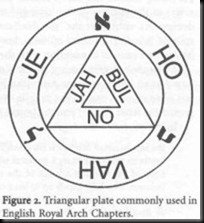 The English Royal Arch ritual provided an altogether different approach. O ritual Inglês Real Arco desde uma abordagem completamente diferente. Rather than the Hebrew‑based cipher‑word, the triangle commonly used in the English Royal Arch workings includes a Hebrew letter set at each corner (Figure 2). Mais do que o hebraico baseado em cifra palavra, o triângulo usado no funcionamento inglês do Real Arco inclui uma letra hebraica definir em cada canto (Figura 2). The "mystical lecture" of the Aldersgate ritual explains that A "palestra mística" do ritual Aldersgate explica que The English Royal Arch ritual provided an altogether different approach. O ritual Inglês Real Arco desde uma abordagem completamente diferente. Rather than the Hebrew‑based cipher‑word, the triangle commonly used in the English Royal Arch workings includes a Hebrew letter set at each corner (Figure 2). Mais do que o hebraico baseado em cifra palavra, o triângulo usado no funcionamento inglês do Real Arco inclui uma letra hebraica definir em cada canto (Figura 2). The "mystical lecture" of the Aldersgate ritual explains that A "palestra mística" do ritual Aldersgate explica que
The characters at the angles of the [triangle] are of exceeding importance, though it is immaterial where the combination is commenced, as each has reference to the Deity, or some divine attribute. Os personagens nos ângulos do [triângulo] são de superior importância, embora seja imaterial, onde a combinação é iniciada, como cada um tem referência à Divindade, ou algum atributo divino. They are the [ aleph ], the [ beth ], and the [ lamed ] of the Hebrew, corresponding with the [ A , B ] and [ L ] of the English Alphabet. Eles são o [Aleph], o [beth], eo [lamed] do hebraico, correspondendo com o [A, B] e [L] do Alfabeto Inglês. Take the [ aleph ] and the [ beth ], they form [ ab ], which is Father; take the [ beth ], the [ aleph ] and the [ lamed ], they form [ bal ], which is Lord; take the [ aleph ] and the [ lamed ], they form [ al ], which means Word; take the [ lamed ], the [ aleph ], and the [ beth ], they form [ lab ], which signifies Heart or Spirit. Pegue o [Aleph] eo [beth], eles formam [ab], que é Pai, tomar a [beth], o [Aleph] eo [lamed], eles formam [bal], que é o Senhor; tomar o [ aleph] eo [lamed], eles formam [al], o que significa Palavra, tomar a [lamed], o [Aleph], eo [beth], eles formam [laboratório], que significa coração ou espírito. Take each combination with the whole, and it will read thus: [ ab , bal ], Father, Lord; [ al , bal ], Word, Lord; [ lab , bal ], Spirit, Lord. [50] Tome cada combinação com o todo, e ele irá ler assim:. [Ab, bal], ó Pai, Senhor; [al, bal] Palavra, Senhor, [laboratório, bal] Espírito, Senhor [50]
This permutation of Hebrew letters is a qabalistic practice known as temurah . Esta permutação de letras hebraicas é uma prática cabalística conhecida como temurah.
In an interesting study, Harry Carr noted that the outlined permutations of the Hebrew letters does not fit the ritualistic interpretation. [51] While it is true that ab , means father , bal , does not mean Lord . Em um estudo interessante, Harry Carr notou que as permutações delineadas das letras hebraicas não cabe a interpretação ritualística. [51] Embora seja verdade que ab, significa pai, bal, não significa Senhor. Brother Carr called this a "childish mis‑spelling" for baal . [52] And indeed, combinations of the letters aleph and lamed mean either el , God , or lo , not , as the Hebrew word for heart is leb , rather than lab . Irmão Carr chamou isso de "infantil mis ortografia" para Baal. [52] E, de fato, as combinações das letras Aleph e Lamed significar tanto el, Deus, ou lo e não, como a palavra hebraica para coração é leb, ao invés de laboratório .
However this may be, it may be noted in passing that the permutation of the three letters comprising the Divine name in Hebrew is a practice which approaches the beginning of the "written Qabalah," and is a subject of extreme importance. [53] Some Qabalistic schools maintain that a mystery is concealed within the permutation of these letters, and that by contemplating their various forms one may obtain enlightenment. [54] The letters represent a primordial Trinity, comprised of the Father, the Mother and the Son. [55] Although it is almost certainly coincidental, it should be noted that the letters of the primordial Trinity–I, H, V combined with those of their alleged Masonic counterparts– A, B, L form IAHBVL (JAHBUL). No entanto, esta pode ser, pode-se notar de passagem que a permutação das três letras que compõem o nome divino em hebraico é uma prática que se aproxima o início da "Qabalah escrita", e é um assunto de extrema importância. [53] Alguns escolas cabalísticas manter um mistério que se esconde dentro da permutação dessas letras, e que, contemplando suas diversas formas pode-se obter a iluminação. [54] As letras representam uma Trindade primordial, composta do Pai, a Mãe eo Filho. [55 ] Embora seja quase certamente coincidência, deve notar-se que as cartas de primordial Trinity-I, H, V combinados com os dos seus presumíveis maçônicos homólogos-A, B, forma L IAHBVL (JAHBUL).
Three English Letters Três letras inglesas
If the above confused attempts to translate Hebrew were not enough, it appears that ritualists, in typical Masonic fashion, have complicated the matter by providing various trinities of letters. Se as tentativas acima confusos para traduzir o hebraico não bastasse, parece que ritualistas, de forma maçônica típica, têm complicado o assunto, fornecendo trindades diferentes de letras. Brother Carr wrote that "the Hebrew characters at the corners of the 'triangle' are not to be found in any of our ritual documents until after the 'standardization' [of the English ritual] in 1834." Irmão Carr escreveu que "os caracteres hebraicos nos cantos do" triângulo "não podem ser encontrados em qualquer um dos documentos nossos rituais após a 'padronização' [do ritual Inglês] em 1834." In spite of Bro. Apesar de Bro. Carr's valued opinion, however, there is ample evidence that three letters were used in connection with the triangle long before this. Opinião valorizado de Carr, no entanto, há evidências de que três letras foram utilizados em conexão com o triângulo muito antes deste.
A pre‑1800 degree known as the Knight of the Royal Arch, which is said to be conferred as an honor in some American jurisdictions, makes use of "a Delta [triangular] plate of gold, and in the middle thereof a five pointed star, on which is engraved the letter [h, yod ] and the letters IBL on the three angles of the plate...." [56] Um grau pré-1800 conhecido como o Cavaleiro do Arco Real, que se diz ser conferida como uma honra em algumas jurisdições americanas, faz uso de "uma placa Delta [triangular] de ouro, e no meio dela uma estrela de cinco pontas , no qual está gravada a letra [h, yod] e as letras IBL nos três ângulos da placa .... " [56]
In the course of the degree, No decurso do grau,
the last initiated brother is let down into [an] arch by the help of two other brethren where he finds a pedestal with a gold Delta [triangular] plate. o último irmão iniciado é deixar para baixo em [um] arco com a ajuda de dois outros irmãos, onde ele encontra um pedestal com um Delta ouro placa [triangular]. On it a copy of the law and a book of the arts and sciences. Sobre ela uma cópia da lei e um livro de artes e ciências. Also a considerable treasure, which he hands up to his 2 companions by means of a rope, retaining only the pedestal with the gold plate affixed to it, after which he is hauled up by them who let him down, having the pedestal and gold plate in his arms. Também um tesouro considerável, que ele entrega-se aos seus companheiros de 2 por meio de uma corda, mantendo apenas o pedestal com a placa de ouro afixada a ele, depois que ele é transportado por eles que deixá-lo para baixo, tendo o pedestal e placa de ouro em seus braços.
After presenting their finds, "the Grand Master addresses the 2 zealous brethren thus, 'dear brethren, among the things you have found, is the real and true Grand Master's Word, which was lost by the death of our respectable Grand Master, Hiram Abiff....'" Depois de apresentar as suas descobertas ", o Grão-Mestre aborda os 2 irmãos zelosos, portanto," queridos irmãos, entre as coisas que você encontrou, é a real e verdadeira Palavra de Grão-Mestre, o que foi perdido com a morte do nosso respeitável Grão-Mestre, Hiram Abiff .... "
Sometime later, the candidates are taught the word: “One is instructed to say I_____; the other B_____; and the third L_____, and so alternately until everyone has completed the same....” Algum tempo depois, os candidatos são ensinados a palavra: "Um é instruído a dizer I_____; o B_____ outro, eo L_____ terceiro, e assim alternadamente até que todos tenham concluído o mesmo ...."
In the 1783 Francken Manuscript version of the Perfect Master degree we read that following Hiram's death a triangular stone was made with the letters IMB engraved thereon, "the I. being the initial of the ancient master's word, and MB the Initials of the new word." Na versão do manuscrito 1783 Francken do grau de Mestre Perfeito lemos que após a morte de Hiram uma pedra triangular foi feito com as letras IMB gravado nela, "o I. sendo a inicial da palavra do antigo mestre, e MB as iniciais da palavra novo . "
This also finds a parallel in the 1782 Rectified Scottish Rite's degree of Scottish Master of Saint Andrew, where we read of "...a square polished stone [upon which is] a triangular gold plate, bearing the sacred word JEHOVA and in the angle thereof the three letters J\B\M\, which are the initials of three words of the preceding grades." [57] Isto também encontra um paralelo em 1782 o grau do Rito Escocês Retificado de Mestre Escocês de Santo André, onde lemos sobre "... uma pedra polida quadrado [em que é] uma placa de ouro triangular, tendo o JEHOVA palavra sagrada e no ângulo mesmo as três letras J \ B \ M \, que são as iniciais de três palavras das séries anteriores ". [57]
We have now encountered the following explanations for four similar sets of letters associated with a triangle: Verificou-se agora encontrado as seguintes explicações para quatro conjuntos semelhantes de cartas associados com um triângulo:
1) The ABL (t, c, k) of the English Royal Arch, with the permutations AB, BAL, LAB, etc. 1) A ABL (t, c, k) do Real Arco Inglês, com as permutações AB, BAL, LAB, etc
2) The I_____B_____L_____ of the Knight of the Royal Arch, being the "lost word." 2) O I_____B_____L_____ do Cavaleiro do Arco Real, sendo a "palavra perdida".
3) The IMB of the 1783 Francken Manuscript , wherein I = the "ancient" word and MB = the "new" word. 3) O IMB do Manuscrito Francken 1783, onde I = a palavra "antiga" e MB = a palavra "novo".
4) The J\B\M\ of the Rectified Scottish Rite signifying the initials of the words of the Craft degrees. 4) O J \ B \ M \ do Rito Escocês Retificado significando as iniciais das palavras dos graus Artesanato.
Which, if any, of these is "correct?" Que, se alguma, dessas é "correto?" What was the original significance of the triangle with three letters? Qual era o significado original do triângulo com três letras?
Possible Trinitarian Origins Possíveis Origens da Trindade
In his excellent study, Some Royal Arch Terms Examined , Roy A. Wells credits Harry Mendoza with a remarkable discovery. Em seu excelente estudo, alguns termos do Real Arco Examinado, Roy A. Wells créditos Harry Mendoza com uma descoberta notável. By substituting Hebrew for Latin on a Christian "Trinitarian Device" (Figure 3) the mysterious aleph , beth and lamed on the British Royal Arch triangle are produced. Substituindo hebraico para a América em um "Dispositivo trinitária" Christian (Figura 3) o aleph misterioso, Beth e Lamed no Royal British Arch triângulo são produzidos.
Latin English Hebrew Latim Inglês Hebraico
Pater Father A b Pater Pai A b
Filius Son B en Filho Filius B en
Spiritus Spirit L eb [58] Spiritus Espírito L eb [58]
 However appealing this appears, the Hebrew scriptures do not use leb as a designation for the Divine Spirit. No entanto este parece atraente, as escrituras hebraicas não use leb como uma designação para o Espírito Divino. The Hebrew text employs Ruach Elohim , "Spirit of God," Ruach YHWH , "Spirit of the Yahweh," and Ruach HaKodesh , "Holy Spirit." O texto hebraico emprega Ruach Elohim, "Espírito de Deus" Ruach YHWH, "Espírito do Senhor", e Ruach HaKodesh, "Espírito Santo". However appealing this appears, the Hebrew scriptures do not use leb as a designation for the Divine Spirit. No entanto este parece atraente, as escrituras hebraicas não use leb como uma designação para o Espírito Divino. The Hebrew text employs Ruach Elohim , "Spirit of God," Ruach YHWH , "Spirit of the Yahweh," and Ruach HaKodesh , "Holy Spirit." O texto hebraico emprega Ruach Elohim, "Espírito de Deus" Ruach YHWH, "Espírito do Senhor", e Ruach HaKodesh, "Espírito Santo".
In connection with this Wells also included an illustration from George Smith's 1785 work, The Use and Abuse of Free‑Masonry , which is strikingly similar to the English Royal Arch triangle. [59] At each corner will be found a Hebrew letter and the triangle is obviously intended as a Trinitarian device. Em conexão com esta Wells também incluiu uma ilustração da obra de George Smith 1785, O Uso e Abuso da Maçonaria, que é muito semelhante ao Inglês Royal Arch triângulo. [59] Em cada canto será encontrada uma letra hebraica eo triângulo é, obviamente, a intenção de ser um dispositivo trinitária. I was initially puzzled to discover the name Elijah in the center–a position logically reserved for Deity. Eu estava inicialmente intrigados para descobrir o nome de Elias na posição de centro-a logicamente reservado para Divindade. Although Elijah means "Yahweh is my God," I believe a better explanation may be found in examining earlier versions of this symbol. Embora Elias significa "Jeová é meu Deus", eu acredito que uma melhor explicação pode ser encontrada no exame versões anteriores deste símbolo.
The earliest form I have been able to locate is presented as Figure 5, taken from Georgius von Welling's Opus Mago‑Cabbilisticum et Theosophicum (1760). [60] The words Geist (German for spirit ), Iehovah and Elohim (Hebrew, God ) surround the triangle, while Eheieh (Hebrew), "I AM," appears in the center. A forma mais antiga que eu tenho sido capaz de localizar é apresentada como Figura 5, tirado de Georgius von Welling Opus Mago-Cabbilisticum et Theosophicum (1760). [60] O Geist palavras (alemão para o espírito), Iehovah e Elohim (em hebraico, Deus) cercam o triângulo, enquanto Eheieh (hebraico): "EU SOU", aparece no centro. The engraver of Smith's frontispiece likely misread the word Eheieh and substituted Elijah . O gravador de frontispício Smith provavelmente interpretou mal a Eheieh palavra e substituiu Elias.
The Alchemical Connection A conexão Alquímica
A careful examination of the Hebrew letters in Figure 4 reveals that other errors may have been made as well. Um exame cuidadoso das letras hebraicas na Figura 4, revela que outros erros podem ter sido feitas também. For example, the letter l, lamed in Figure 4 (at the apex of the triangle) appears to have originally been the letter n, nun . Por exemplo, a letra l, lamed na Figura 4 (no vértice do triângulo) parece ter sido originalmente a letra N, nun. Another illustration in von Welling's Opus (Figure 6) provides another arrangement of the letters around the triangle. Outra ilustração em von Welling Opus (Figura 6) fornece um outro arranjo das cartas ao redor do triângulo. Although their arrangement differs, the letters are again ABN. Embora a sua disposição é diferente, as letras são novamente ABN. It will be noticed that an enlargement of the detail (Figure 6‑A) resembles the triangle used in at least one Canadian jurisdiction (Figure 7), which it inherited from England. [61] Será notado que um alargamento da detalhe (Figura 6-A) assemelha-se o triângulo utilizados em pelo menos uma competência Canadian (Figura 7), que é herdado de Inglaterra. [61]

Von Welling's diagrams are said to be based on the "Rosicrucian teachings" of Johannes Baptist van Helmont (1577‑1644), an early alchemist and scientist, who claimed to have manufactured the elixir vitæ , the universal medicine capable of curing all human ailments and prolonging mortal life. [62] Van Helmont, in turn, was influenced by Heinrich Khunrath (1560‑1605), another alchemist, of whom Arthur Edward Waite writes, "Even for an alchemist he was of a strange an exotic kind, and because of certain symbolical plates which are attached to his chief work he has been connected with the Rosicrucian Brotherhood, either as a precursor or member." [63] Von Welling diagramas são disse a basear-se nos "ensinamentos Rosacruzes" de Johannes Baptist van Helmont (1577-1644), um alquimista cedo e cientista, que afirmou ter fabricado o elixir da vida, a medicina universal capaz de curar todas as doenças humanas e prolongar a vida mortal. [62] Van Helmont, por sua vez, foi influenciado por Heinrich Khunrath (1560-1605), outro alquimista, de quem Arthur Edward Waite escreve: "Mesmo para um alquimista que era de um tipo um estranho exótico, e porque de certas placas simbólicas que acompanham a sua obra principal, ele tem sido relacionada com a Fraternidade Rosacruz, ou como um precursor ou um membro ". [63]
![clip_image010[6]](https://blogger.googleusercontent.com/img/b/R29vZ2xl/AVvXsEhHZ4sWtxmC8nRYFzo_eJzwzkMjDwtJhjW3epB88-mbi1Dfc6a2DjDn7F3sLwF_PEZcr08Ou2JT-BVqx-2lWegKkgkn-vf51A70xP8ipPXsptxVOKXoT0QqxHe9LTqiZOIBzLTPJw1stPtM/?imgmax=800 "clip_image010[6]")
The symbolical plates to which Waite refers appear in Khunrath's postumously‑published Amphithætrum Sapientiæ Æternæ (1609), which Waite describes as "a text of purely spiritual and mystical alchemy." [64] As placas simbólicas para que Waite se refere aparecem em postumously publicado Khunrath do Amphithætrum Sapientiae aeternae (1609), que Waite descreve como "um texto de alquimia puramente espiritual e mística". [64]
 Just as there is operative and speculative Masonry, there is likewise spiritual and practical alchemy. Assim como existe a Maçonaria operativa e especulativa, há também a alquimia espiritual e prática. Both use the same arcane symbolism, just as we, as Speculative Masons, retain the Operative Mason's tools and terminology. Ambos usam o mesmo simbolismo arcano, assim como nós, como maçons especulativos, conservar as ferramentas do pedreiro operativo do e terminologia. Spiritual alchemy, which was chiefly a pursuit of medieval mystics, maintained that Christian enlightenment could be obtained through certain practices which were described in an intentionally confusing jargon. Alquimia espiritual, que era principalmente uma busca de místicos medievais, sustentou que a iluminação cristã poderia ser obtida através de certas práticas que foram descritos em um jargão intencionalmente confusa. Today, it has been described as a type of primitive psychology and a means of self‑improvement. [65] This explains the alchemical aphorism aurum nostrum non est aurum vulgi (our gold is not the common gold). Hoje, ele tem sido descrito como um tipo de psicologia primitiva e um meio de auto-aperfeiçoamento. [65] Isto explica o aforismo alquímico aurum nostrum non est aurum vulgi (nosso ouro não é o ouro comum). Practical alchemists, however, attempt to alter the properties of matter, sometimes through psycho‑chemical means. [66] Those who seek to enrich themselves by alchemical methods are contemptuously called "puffers." Alquimistas práticos, no entanto, tentar alterar as propriedades da matéria, por vezes através de psico-químicas meios. [66] Aqueles que procuram enriquecer-se por métodos alquímicos são desdenhosamente chamados de "Peixes". Just as there is operative and speculative Masonry, there is likewise spiritual and practical alchemy. Assim como existe a Maçonaria operativa e especulativa, há também a alquimia espiritual e prática. Both use the same arcane symbolism, just as we, as Speculative Masons, retain the Operative Mason's tools and terminology. Ambos usam o mesmo simbolismo arcano, assim como nós, como maçons especulativos, conservar as ferramentas do pedreiro operativo do e terminologia. Spiritual alchemy, which was chiefly a pursuit of medieval mystics, maintained that Christian enlightenment could be obtained through certain practices which were described in an intentionally confusing jargon. Alquimia espiritual, que era principalmente uma busca de místicos medievais, sustentou que a iluminação cristã poderia ser obtida através de certas práticas que foram descritos em um jargão intencionalmente confusa. Today, it has been described as a type of primitive psychology and a means of self‑improvement. [65] This explains the alchemical aphorism aurum nostrum non est aurum vulgi (our gold is not the common gold). Hoje, ele tem sido descrito como um tipo de psicologia primitiva e um meio de auto-aperfeiçoamento. [65] Isto explica o aforismo alquímico aurum nostrum non est aurum vulgi (nosso ouro não é o ouro comum). Practical alchemists, however, attempt to alter the properties of matter, sometimes through psycho‑chemical means. [66] Those who seek to enrich themselves by alchemical methods are contemptuously called "puffers." Alquimistas práticos, no entanto, tentar alterar as propriedades da matéria, por vezes através de psico-químicas meios. [66] Aqueles que procuram enriquecer-se por métodos alquímicos são desdenhosamente chamados de "Peixes".
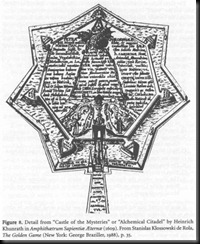
Khunrath included a plate depicting the "Castle of the Mysteries" or "Alchemical Citadel" (detail, Figure 8). [67] Sitting atop the citadel is a winged dragon, over the head of which appears a luminous triangle with the same Hebrew letters that appeared in von Welling's Opus Mago‑Cabbilisticum et Theosophicum : aleph , beth , and nun , or ABN. Khunrath incluídos uma placa que descreve o "Castelo dos Mistérios" ou "Citadel Alquímico" (detalhe, Figura 8). [67] Sentando-se sobre a cidadela é um dragão alado, sobre a cabeça dos quais aparece um triângulo luminoso com as mesmas letras hebraicas que apareceu na von Welling Opus Mago-Cabbilisticum et Theosophicum: aleph, beth, e freira, ou ABN.
![clip_image012[4]](https://blogger.googleusercontent.com/img/b/R29vZ2xl/AVvXsEiUZn7smw3chso4Fh78NdD4k98c7MZNw6MDNfkTvo1HuE2j7OOJs7f-tlWSqxICjFKCcqt3OBcAKWV1QjMnKrwIJJUT4EFYZZXRlkdwXjF74F_5G3-1lXI6jR_nZ1EwObQT-Cpy97RaouzU/?imgmax=800 "clip_image012[4]") In Khunrath's plate, however, the letter n, nun , appears in terminal form indicating that it the last letter of a word and that the letters are intended to spell out the Hebrew word ehben stone (Figure 9). Na placa Khunrath, no entanto, a letra n, freira, aparece em forma terminal indicando que a última letra de uma palavra e que as cartas se destinam a soletrar a palavra hebraica ehben pedra (Figura 9). The text explains that the triangular stone represents the hermetic lapis philosophorum (philosopher's stone) and lapis angularis (corner stone). O texto explica que a pedra triangular representa a hermética lapis philosophorum (pedra filosofal) e lapis angularis (pedra angular). Khunrath, a Christian Qabalist, equated the lapis philosophorum with the Ruach Elohim or "Spirit of God" of Genesis 1:2. Khunrath, um cabalista cristão, igualou o philosophorum lapis com o Ruach Elohim ou "Espírito de Deus" de Gênesis 1:2. The lapis angularis is identified in New Testament scriptures (Acts 4:10‑11; 1 Peter 2:6‑8) as Jesus Christ, who, as the ehben masu ha‑bonim , or "stone rejected by the builders" of Psalms 118:22, became the "head of the corner". O angularis lapis é identificado nas Escrituras do Novo Testamento (Atos 4:10-11, 1 Pedro 2:6-8) como Jesus Cristo, que, como o masu ehben ha-Bonim, ou "pedra rejeitada pelos construtores" do Salmo 118 : 22, tornou-se o "cabeça da esquina". In Khunrath's plate, however, the letter n, nun , appears in terminal form indicating that it the last letter of a word and that the letters are intended to spell out the Hebrew word ehben stone (Figure 9). Na placa Khunrath, no entanto, a letra n, freira, aparece em forma terminal indicando que a última letra de uma palavra e que as cartas se destinam a soletrar a palavra hebraica ehben pedra (Figura 9). The text explains that the triangular stone represents the hermetic lapis philosophorum (philosopher's stone) and lapis angularis (corner stone). O texto explica que a pedra triangular representa a hermética lapis philosophorum (pedra filosofal) e lapis angularis (pedra angular). Khunrath, a Christian Qabalist, equated the lapis philosophorum with the Ruach Elohim or "Spirit of God" of Genesis 1:2. Khunrath, um cabalista cristão, igualou o philosophorum lapis com o Ruach Elohim ou "Espírito de Deus" de Gênesis 1:2. The lapis angularis is identified in New Testament scriptures (Acts 4:10‑11; 1 Peter 2:6‑8) as Jesus Christ, who, as the ehben masu ha‑bonim , or "stone rejected by the builders" of Psalms 118:22, became the "head of the corner". O angularis lapis é identificado nas Escrituras do Novo Testamento (Atos 4:10-11, 1 Pedro 2:6-8) como Jesus Cristo, que, como o masu ehben ha-Bonim, ou "pedra rejeitada pelos construtores" do Salmo 118 : 22, tornou-se o "cabeça da esquina".
The three Hebrew letters at the corners of the triangle are a symbol of Christ, who was the "Word" (Logos) of John 1:1. As três letras hebraicas nos cantos do triângulo é um símbolo de Cristo, que era o "Verbo" (Logos) de João 1:1. Perhaps significantly, the Pretiosa Margarita Novella , an alchemical text by Petrus Bonus, written ca . Talvez de forma significativa, o pretiosa Margarita Novella, um texto alquímico por Petrus Bonus, escrita ca. 1330‑1339, also connected the "stone" with the phrase "In the beginning was the word." [68] The Royal Order of Scotland likewise comes into play in this regard. 1330-1339, também ligado a "pedra" com a frase "No princípio era o verbo". [68] A Ordem Real da Escócia também entra em jogo a este respeito. This order, which may have existed as early as 1737, [69] includes the following catechism: Esta ordem, que pode ter existido tão cedo quanto 1737, [69] inclui o catecismo seguinte:
Q. How many rule a Lodge? P. Quantas regra Lodge uma?
A. Three. A. Três.
Q. Why so? P. Por que isso?
A. For three reasons. A. Por três razões.
Q. Give me the first. P. Dá-me o primeiro.
A. Because there are three terms in a syllogism by which we discover truth, the major and the minor proposition and the conclusion. A. Como há três termos em um silogismo em que descobrimos a verdade, a maior ea proposição menor ea conclusão.
Q. And what is the second?
A. Because there are three sides in an equilateral triangle, which is an emblem of the third.
Q. And what it the third?
A. Because there are Three Persons in the Holy Trinity–Father, Son and Holy Ghost, One God. * * * ***
Q. Right Worshipful Senior Grand Warden, what in Masonry is said to represent the Son of Man?
A. The Perpend‑ashlar.
Q. What is the Perpend‑ashlar otherwise called?
A. The Stone which the Builders rejected, which is now become the Chief Stone of the Corner, or the most perfect pattern for Masons to try their Moral Jewels upon.
It may be noted that the Royal Order makes use of the word Jubilon . Pode-se notar que a ordem real faz uso da Jubilon palavra. In addition to the obvious Trinitarian symbolism of the triangle, by a strange coincidence, the word ehben also conforms to Harry Mendoza's Trinitarian explanation of the symbol, as alchemist "Joachim Frizius" [pseud. Além do simbolismo trinitário óbvio do triângulo, por uma estranha coincidência, o ehben palavra também está de acordo com explicação trinitário Harry Mendoza do símbolo, como alquimista "Joachim Frizius" [pseud. of Robert Fludd?], [70] in his Summum Bonum (1629) explains, "Aben (ict) means a stone. In this one cabalistic stone we have the Father, Son and Holy Ghost ... for in Hebrew Ab means Father and Ben Son. But where the Father and Son are present there the Holy Ghost must be also...." [71] de Robert Fludd?], [70] em seu Summum Bonum (1629) explica, "Aben (TIC) significa uma pedra. Neste pedra um cabalístico temos o Pai, Filho e Espírito Santo ... para em hebraico significa Ab Pai Filho e Ben. Mas onde o Pai eo Filho estão presentes há o Espírito Santo deve ser também .... " [71]
It is difficult to read the above without being reminded of the mystical lecture 's attempted explanation of the letters ABL in the English Royal Arch triangle. É difícil ler o trecho, sem ser lembrado de explicação tentada a palestra mística 's das letras ABL no triângulo Inglês do Real Arco. Recall that in the two oldest Masonic legends cited, the 1782 Rectified Scottish Rite, and the 1783 Francken Ma nuscript, the triangle is connected with a stone . Lembre-se que nos dois mais antigos lendas maçônicas citado, a 1782 Rito Escocês Retificado, eo 1783 Francken nuscript Ma, o triângulo é conectado com uma pedra.
Speculative Etymology and Speculative Masonry Etimologia especulativo e Maçonaria Especulativa
Is it possible that confused or incorrect Hebrew letters in diagrams and documents resulted in the variety of Compound Words? É possível que as letras hebraicas confusas ou incorretas em diagramas e documentos resultou na variedade de palavras compostas? Was the "Word" based upon Hermetic designs such as those in Smith's Use and Abuse of Freemasonry , von Welling's Opus , and their antecedent, the Amphithætrum Sapientiæ Æternæ ? Foi a "Palavra" com base em desenhos herméticos, tais como aqueles em uso de Smith e de Abuso de Maçonaria, Opus von Welling, e seu antecedente, o Amphithætrum Sapientiae aeternae?
AE Waite, in his Secret Tradition in Freemasonry (1937), cites another Royal Arch legend which may have some bearing on this. AE Waite, em sua Tradição Secreta da Maçonaria (1937), cita outra lenda do Real Arco que pode ter alguma influência sobre isso. In the degree of Chevalier de la Royale Arche, "a triangular stone [is discovered], bearing in its centre the name of God in Hebrew and one of the three following letters at the three angles: I\B\M\, held to be 'the initials of the True Name borne by our Grand Master.'" No grau de Chevalier de la Royale Arche, "uma pedra triangular [é descoberto], tendo em seu centro o nome de Deus em hebraico e uma das três letras seguintes, nos três ângulos: I \ B \ M \, realizada a ser "as iniciais do nome verdadeiro suportados pelo nosso Grande Mestre. '"
Waite adds that Waite acrescenta que
A crude coloured vignette is affixed to the beginning of the manuscript, representing the jewel of the Grade, an Arch, having a pedestal beneath and thereon a triangle inscribed with the word JABULUM, which cannot be translated as it stands. Uma vinheta de cor crua é aposta para o início do manuscrito, o que representa a jóia do Grau, um Arch, com um pedestal abaixo e nele um triângulo inscrito com a palavra JABULUM, que não pode ser traduzido como está. It may be compared with the initials cited in the text above and is evidently placed in apposition to the Divine Tetragram, described as the name of God in Hebrew. [72] Pode ser comparado com as iniciais citadas no texto acima e é evidentemente colocado em justaposição com o Tetragrama Divino, descrito como o nome de Deus em hebraico. [72]
If we consider the origins of the word Jehovah we may find a parallel in the Compound Word. Se considerarmos as origens da palavra Jeová, podemos encontrar um paralelo na palavra composta. The word was formed circa 1500 CE by combining the consonants of the Tetragrammaton JHVH or YHWH with the vowels of the word adonai , Lord, hence, JaHoVaH. A palavra foi formada por volta de 1500 dC, combinando as consoantes do Tetragrama JHVH ou YHWH com as vogais da palavra Adonai, Senhor, portanto, Jahovah.
Perhaps by some similar method the variants Jah‑Bu‑Lum , Iao‑Bul‑On , Jah‑Bel‑On , etc., were obtained from combinations of the letters ABL, IBL, IMB and JBM, supplemented with vowels. Clearly, with a combination of these letters, only minor syllabic shifts are necessary for the construction of such "words." The accidental substitution of ABL in Smith's Use and Abuse of Freemasonry (Figure 4) for the ABN (stone) in von Welling's Opus (Figure 5) lends itself to such a suggestion, as readily as AE Waite observed, IBM yields JABULUM.
Once the origin of the letters in the corner of the triangle were forgotten enterprising ritualists may have attempted to "restore" or explain their significance with fanciful interpretations. Did the ritualistic citation of John 1:1, long connected with the stone, hint at the solution all along? If so, the Compound Word concealed the Mystery of the Trinity, and quite literally, for the Masons who introduced this cryptogram, THE WORD WAS GOD.
REFERENCES Referências
Albertus, Frater. Alchemist's Handbook , rev. enl. ed. ed. York Beach, ME: Samuel Weiser, 1987.
Allen, Paul M. A Christian Rosenkreutz Anthology , 3d rev. ed. ed. Blauvelt, NY: Spiritual Science Library, 1968, 1981.
Allyn, Avery. A Ritual of Freemasonry. Philadelphia: John Clarke, 1831.
Authorized Copy of Ritual for Subordinate Chapters of Manitoba. Manitoba: Grand Chapter of Royal Arch Masons, 1987.
Atwood, Mary Anne. A Suggestive Inquiry into Hermetic Mystery. Belfast: William Tait, 1918.
Barrett, Francis. The Magus, or Celestial Intelligencer . London: Lackington, Allen and Co., 1801.
Beyond the Pillars: More Light on Freemasonry . Grand Lodge AF&A.M. of Canada in the Province of Ontario, 1973.
Bernard, David. Light on Masonry . Utica: William Williams, 1829.
Box, Hubert S. The Nature of Freemasonry . London: Augustine Press, 1952.
Budge, EAW Amulets and Superstitions . London: Oxford University Press, 1930.
Burckhardt, Titus. Alchemy: Science of the Cosmos, Science of the Soul. Baltimore: Penguin Books, 1971.
Carlile, Richard. Manual of Freemasonry . London, ca. 1825.
Carr, Harry, ed. Early French Exposures . London: Quatuor Coronati Lodge No. 2076, 1971.
------. World of Freemasonry . London: A Lewis, 1983.
de Castells, F. The Genuine Secrets of Freemasonry , reprint ed. London: A Lewis, 1978.
The Ceremony of the Rose Croix of Heredom–The 18° of the A. and A. Rite . London: Privately printed for the Supreme Council, 33°.
Charles, RH The Book of Enoch . London: SPCK, 1917.
Charlesworth, James H. ed. The Old Testament Pseudepigrapha , 2 vols. Garden City, NY: Doubleday & Co., 1983.
Circular throughout the two Hemispheres . Charleston, SC, 1802.
Coil, Henry W. Freemasonry Through Six Centuries , 2 vols. Richmond: Macoy, 1967.
------. Masonic Encyclopedia . New York: Macoy, 1961.
Collectanea (Grand College of Rites, USA), vol. 11 (1980).
Crafts, George R. The Mysteries of Free Masonry. New York: Wilson and Co., 1852.
Cross, Jeremy L. The True Masonic Chart . New Haven: Doolittle, 1820.
Culling, Louis. A Manual of Sex Magick . St. Paul: Llewellyn, 1971.
Fourteenth Degree–Grand Elect Mason . Lexington, Mass.: Supreme Council, 33°, NMJ, 1976.
de Givry, Grillot. Witchcraft, Magic & Alchemy . Houghton Mifflin Co., 1931.
deHoyos, Art. The Cloud of Prejudice: A Study in anti‑Masonry , 2d ed. Kila, Mont.: Kessinger Publishing Co., 1992, 1993.
Denslow, Ray V. Masonic Rites and Degrees . Transactions of the Missouri Lodge of Research, 1955.
Dewar, James .The Unlocked Secret. London: William Kimber, 1966.
Flowers, S. Eldred. Fire & Ice: Magical Teachings of Germany's Greatest Secret Occult Order . St. Paul: Llewellyn, 1990.
Francken, Henry Andrew . Manuscript Rituals and Regulations , [1783]. Archives, Supreme Council, 33°, NMJ, Lexington, Mass.
Gilchrist, Cherry. Alchemy: The Great Work . Wellingborough: Aquarian Press, 1984.
"Grand Elect Perfect and Sublime Master (or Mason)," Secret Directory of Manuscripts of the Ineffable Degrees, [1850]. Supreme Council, 33°, NMJ [JJJ Gourgas Supreme Council].
Hall, Manly P. The Secret Teachings of All Ages . San Francisco: HS Crocker, 1928; reprint ed., Los Angeles: Philosophical Research Society, 1977.
Hannah, Walton. Darkness Visible . London: Augustine Press, 1952.
Higgins, Godfrey. Anacalypsis, an Attempt to Draw Aside the Veil of the Saitic Isis , 2 vols. London: Longman, Rees, Ormes, Brown, Green, and Longman, 1836.
Hinman, Eugene E. Ray V. Denslow and Charles C. Hunt. A History of the Cryptic Rite , 2 vols. General Grand Council, R,&S,M., 1931.
Hunt, Charles C. Lessons in Capitular Masonry , 4 vols. Grand Chapter, RAM of Iowa, 1927‑1932; reprint ed., General Grand Chapter, RAM International, 1971.
Hutchens, Rex R. A Bridge to Light . Supreme Council, 33°, SJ 1988.
Hyatt, Christopher S. [Alan Miller]. Secrets of Western Tantra . Las Vegas: Falcon Press, 1989.
Jackson, ACF Rose Croix , rev. ed. ed. London: A Lewis, 1987.
Jones, Bernard E. Freemasons Book of the Royal Arch , rev. by Harry Carr and AR Hewitt. London: Harrap, 1969.
Jung, Carl G. Psychology and Alchemy. Princeton: Princeton University Press, 1953, 1968.
Kaplan, Aryeh. Meditation and Kabbalah . York Beach, Maine: Samuel Weiser, 1982.
------. Meditation and the Bible . York Beach, Maine: Samuel Weiser, 1978.
------. Sefer Yetzirah: The Book of Creation . York Beach, Maine: Samuel Weiser, 1990.
Khunrath, Heinrich Conrad. Amphithætrum Sapientiæ Æternæ Solius Veræ, Christiano‑Kabalisticum, Divino‑Magicum, nec non Physico‑Chemicum, Tertriunum, Catholicon . Hanau: E. Wolfart, 1609.
King, Francis. The Secret Rituals of the OTO London: CW Daniel Co., 1973.
------. Sexuality, Magic and Perversion . Secaucus, NJ: Citadel Press, 1972.
------. Tantra for Westerners . New York: Destiny, 1986.
Laffon‑Ladebat, Charles. Ancient and Accepted Scotch Rite, Eighteenth Degree . New Orleans, 1856.
Lindner, Erich J. The Royal Art Illustrated . Graz: Akademische Druck und Verlagsanstalt, 1976.
Mackey, Albert G. An Encyclopedia of Freemasonry , ed., rev., and enl. by Robert I. Clegg with suppl. vol. by HL Haywood, 3 vols. Chicago: Masonic History, 1929; 1946.
Mathers, SL MacGregor. The Kabbalah Unvailed . London: Routledge & Kegan Paul, 1926.
Memory Aid for Chapter Work as Permitted by the Grand Royal Arch Chapter of Texas , rev. ed. ed. Richmond: Macoy, 1984.
Moore, WA "The Irish RA Legend," The Research Chapter of New Zealand of Royal Arch Masons No. 95 , Vol. 6, No. 2, (March 1987) pp. 19‑27.
The Official Ritual–-Heredom of Kilwinning and Rosy Cross . Edinburgh: Grand Lodge of the Royal Order of Scotland, 1953.
Oliver, George. Rite Ancient de Bouillon . 1740(?) .
Pick ,Fred L. and G. Norman Knight, The Freemason's Pocket Reference Book , 3d rev. ed. ed. London: Frederick Muller, Ltd., 1983.
[Pike, Albert.] The Inner Sanctuary, Part I. The Book of the Lodge of Perfection . reprint ed. Supreme Council, 33°, SJ, 1962.
------. The Inner Sanctuary, Part IV. The Book of the Holy House . [New York?], A\M\ 5644 [1884].
------. Liturgy of the Ancient and Accepted Scottish Rite of Freemasonry for the Southern Jurisdiction of the United States, Part II , rev. ed. ed. 1962; reprint ed., Springfield, VA: Goetz Printing Co., 1982.
------. [ The Magnum Opus ]. Np, [1857].
------. lu,v rsvu okutv The Porch and the Middle Chamber vfxv rpx The Book of the Lodge. Ierodom: A\M\ 5632 [New York?, 1872].
------. [Secret Work], IV °‑XIV° . Np, 5722 A\M\, 1962 V\E\.
------. Sephar h'Debarim–-The Book of the Words. Np A\M\ 5638 [1878].
Ponce, Charles. Kabalah . Wheaton, Ill.: Quest Books, 1983.
Regardie, Israel. A Garden of Pomegranates: An Outline of the Qabalah , 2d rev. ed. ed. St. Paul, Minn.: Llewellyn, 1970.
------. The Philosopher's Stone: A Modern Comparative Approach to Alchemy from the Psychological and Magical Points of View . London: Rider & Co., 1938.
------. The Tree of Life: A Study in Magic . York Beach, Maine: Samuel Weiser, 1972.
Riessler, Paul. Altjüdisches Schrifttum außerhalb der Bibel. Heidelberg: FH Kerle Verlag, 1928, 1975.
Ritual of the A.&A. Egyptian Rite of Memphis, 96° . Sovereign Sanctuary of Canada, [ca. 1882].
Ritual of the Grand Chapter of Royal Arch Masons of the State of California . Grand Chapter of California, RAM, 1974.
The Ritual of Holy Royal Arch as Taught in the Aldersgate Chapter of Improvement No. 1657. London: A Lewis, 1938.
Rituals for the Degrees of Mark Master, Past Master, Most Excellent Master and Royal Arch . Grand Chapter of Royal Arch Masons of the State of Ohio, 1989.
Saint‑Gall, Michel. Dictionnaire des Hebraismes et d'Autres Termes Specifiques d'Origine Francaise, Etrangere ou Inconnue dans le Rite Ecossais et Accepte . Paris: Editions Demeter, 1988.
Scholem, Gershom. Kabbalah . New York: Dorset, 1987.
Sheville, John and James L. Gould. Guide to the Royal Arch Chapter . New York: Masonic Publishing, 1867.
Shute, J. Ray. "The Innovators," Collectanea (Grand College of Rites, USA), vol 10, no. 1, 1975.
Silberer, Herbert. Problems of Mysticism and its Symbolism . New York: Moffat, Yard and Co., 1917.
Slusher, William F. "Resolution No. 4" in Address of the Grand High Priest, Grand Royal Arch Chapter of Texas and Capitular Review. Proposed Resolutions, 1991 . Waco, Tex.: Grand Royal Arch Chapter, 1991.
Smith, George .The Use and Abuse of Free‑Masonry . London: G. Kearsley, 1785.
Strong, James. A Concise Dictionary of the Words in the Hebrew Bible . Madison, NJ, 1890.
The Text Book of Advanced Freemasonry . London: Reeves and Turner, 1873.
Thirteenth Degree–Master of the Ninth Arch . Lexington, MA: Supreme Council 33°, 1977.
Frater U\D\, Secrets of the German Sex Magicians . St. Paul: Llewellyn, 1991.
Unmarked Manuscript Book, BX 31. Archives, Supreme Council, 33°, SJ, Washington, DC
Voorhis, HVB Masonic Rituals: Templar, KTP, Female, Misc. Unpublished Voorhis ritual collection, vol. 1737.
Waite, Arthur Edward. The Brotherhood of the Rosy Cross . London: William Rider & Son, 1924.
------, trans., The Liturgy of the Rite of the Strict Observance Reformed and Rectified . Np, 1905; reprinted in Frederick F. Bahnson, The Rite of Strict Observance, CBCS [Warrenton, NC: Privately Printed by J. Edward Allen, 1934].
------. The Secret Tradition in Alchemy . London, 1926.
------. The Secret Tradition in Freemasonry [2d ed.]. London: William Rider, 1937.
Wells, Royal A. Some Royal Arch Terms Examined ,2d ed. London: A Lewis, 1978, 1988.
Whiston, William .Josephus: Complete Works . [1737?] Edinburgh: William P. Nimmo, 1867; reprint ed., Grand Rapids: Kregal, 1981.
Wrixon, Fred B. Codes, Ciphers and Secret Languages . New York: Bonanza Books, 1989.
NOTES NOTAS
[1] . Third stanza, "Ode for Closing the Grand Lodge of Perfection," Secret Directory of Manuscripts of the Ineffable Degrees (1850) Supreme Council, 33°, NMJ (JJJ Gourgas Supreme Counci).
[2] . The Rite of Perfection consists of the fourth through the fourteenth degrees of the Scottish Rite, and was a carry‑over from Stephen Morin's Rite, preserved in the 1783 Francken Manuscript , which formed the basis of the A.&A.SR With the exception of the 9°, "Master Elected of Nine," and the 10°, "Illustrious Elected of Fifteen," (both vengeance degrees imported from the Adoniramite Rite), each degree in the 1783 Francken Manuscript 's Rite of Perfection employs a variant of, or substitution for, the Divine name as a "significant word."
[3] . The standard reference on the subject is Bernard E. Jones, Freemasons Book of the Royal Arch rev. by Harry Carr and AR Hewitt (London: Harrap, 1957; 1969), but see also "More Light on the Royal Arch" and "The Relationship Between the Craft and the Royal Arch," in Harry Carr, World of Freemasonry (London: A Lewis, 1983), pp. 163‑179, 335‑366.
[4] . According to Albert G. Mackey, "In the third chapter of that book [Exodus], when Moses asks of god what is His name, He replies 'I am that I am.;' and He said, 'Thus shalt thou say unto the children of Israel, I am hath sent me unto you,' and He adds, 'this is my name forever.' Now, the Hebrew word I am is, Ehyeh . But as Mendelsohn has correctly observed, there is no essential difference between vhvt, in the sixth chapter and vuvh in the third, the former being the first person singular, and the latter the third person of the same verb, the future used in the present sense of the verb to be ; and hence what was said of the name Ehyeh was applied by the Rabbis to the name Jehovah . But of Ehyeh God had said, 'this is may name forever.' Now the word forever is represented in the original by l'olam ; but the Rabbis, says Capellus, by change of a single letter, made l'olam , forever , read as if it had been written l'alam , which means to be concealed , and hence the passage was translated 'this is my name to be concealed,' instead of 'this is my name forever.'" "Jehovah," Albert G. Mackey, An Encyclopedia of Freemasonry , ed., rev., and enl. by Robert I. Clegg with suppl. vol. vol. by HL Haywood, 3 vols. (Chicago: Masonic History, 1929; 1946), vol. 1, 501.
[5] . For example, the Irish Royal Arch ritual differs from the American York Rite, the Scottish Rite and the English Royal Arch, in that its principal characters are King Josiah, Shaphan and Hilkiah the priest. See WA Moore, "The Irish RA Legend," The Research Chapter of New Zealand of Royal Arch Masons No. 95 , vol. 6, no. 6, n. 2 (March 1987), pp. 19‑27.
[6] . "The Development of Ecossais Masonry in France," ACF Jackson, Rose Croix rev. ed. ed. (London: A Lewis, 1980; 1987), pp. 31‑45.
[7] . Albert G. Mackey, An Encyclopedia of Freemasonry , ed., rev., and enl. by Robert I. Clegg with suppl. vol. vol. by HL Haywood, 3 vols. (Chicago: Masonic History, 1929; 1946), sv Enoch.
[8] . Samuel Lee, Orbis Miraculum (1659), p. 370, as quoted in Harry Carr, "The Relationship Between the Craft and the Royal Arch," in Harry Carr's World of Freemasonry (London: A Lewis, 1983), p. 359. 359.
[9] . 1 Enoch XVIII. RH Charles, The Book of Enoch (London: SPCK, 1917), pp. 44‑45.
[10] . 1 Enoch 14:24.
[11] . The "Lecture" of Thomas Smith Webb's Royal Arch ritual (which served as the foundation of the American York Rite) states in part: "We learn from sacred history and from the writings of Josephus ... ."
[12] . According to William Whiston, Josephus mistook "...Seth the son of Adam for Seth or Sesostris, king of Egypt, the erector of this pillar in the land of Siriad...." Josephus: Complete Works ([1737? ] Edinburgh: William P. Nimmo, 1867; reprint ed., Grand Rapids: Kregal, 1981), p. 27. 27.
[13] . Aryeh Kaplan, Meditation and the Bible (York Beach, ME: Samuel Weiser, 1978), p. 58. 58.
[14] . Kaplan, p. [14] . Kaplan, p. 159, fnt. 40. 40.
[15] . "Few Americans realize the difference in rituals of the Royal Arch. Only in America do we find the Imitation Ark, an invention of Thomas Smith Webb, father of the American York Rite, and the best argument that the Select Master, which deals with said Ark, had to be an American invention...." J. Ray Shute, "The Innovators," Collectanea (Grand College of Rites, USA), vol. 10, no. 10, n. 2 (1975), p. 100. 100.
[16] . F. de Castells, The Genuine Secrets of Freemasonry (reprint ed., London: A Lewis, 1978), p. 208. 208.
[17] . Memory Aid for Chapter Work as Permitted by the Grand Royal Arch Chapter of Texas rev. ed. ed. (Richmond: Macoy, 1984), p. 154. 154.
[18] . Scriptural anachronisms abound in Masonic rituals. In many American Jurisdictions, the Mark Masters degree retains anachronistic readings of Matthew 20:1‑16; 21:42; Mark 12:10; Luke 20:17; Acts 4:11 and Revelation 2:17. Other jurisdictions, such as California, substitute 2 Chronicles 2:16, and the anachronistic Ezekiel 44:1‑3. Ritual of the Grand Chapter of Royal Arch Masons of the State of California (Grand Chapter RAM, 1974), pp. 20‑21.
[19] . Jeremy L. Cross, The True Masonic Chart (New Haven: Doolittle, 1820), p. 114; John Sheville and James L. Gould, Guide to the Royal Arch Chapter (New York: Masonic Publishing, 1867), p. 171. 171.
[20] . Godfrey Higgins, Anacalypsis, an Attempt to Draw Aside the Veil of the Saitic Isis , 2 vols. (London: Longman, Rees, Ormes, Brown, Green, and Longman, 1836), vol. 1, p. 1, p. 832.
[21] . Representations of the pedestal and plate, as used in the Supreme Council, 33°, SJ, may be found in Albert Pike, Liturgy of the Ancient and Accepted Scottish Rite of Freemasonry Part II (Charleston, A\M\ 5722; reprint ed., Springfield: Goetz Printing Co., 1982), pp. 148, 174; [Albert Pike,] The Inner Sanctuary Part I. The Book of the Lodge of Perfection (reprint ed. Supreme Council, 33°, SJ, USA,, 1962), p. 250. 250. Depending on jurisdiction, the golden plate may be inscribed in any number of languages, including Hebrew, Samaritan, Phoenician, and Sanskrit.
[22] . Thomas S. Webb's Royal Arch ritual explains that after penetrating the vault, the investigators discovered "in the north east corner thereof, on a pedestal, a box of an oblong form, overlaid with gold, on the top and sides of which were several mysterious characters." Versions of the Royal Arch Cipher are reproduced in Fred L. Pick and G. Norman Knight, The Freemason's Pocket Reference Book , 3d rev. ed. ed. (London: Frederick Muller, Ltd., 1955, 1965, 1983), p. 73, and Beyond the Pillars: More Light on Freemasonry (Grand Lodge AF&A.M. of Canada in the Province of Ontario, 1973), p. 92. 92. The cipher is sometimes mistakenly called the "Rosicrucian cipher," as in Fred B. Wrixon, Codes, Ciphers and Secret Languages (New York: Bonanza Books, 1989), pp. 69‑75.
[23] . In some American jurisdictions the Compound Word is denominated the key word or covering word, while another word is considered the Grand Omnific Royal Arch Word . Other jurisdictions maintain that the compound word together with another word constitute the Grand Omnific Royal Arch Word , or the long lost Master's Word , the Royal Arch Word , the Grand Omnific Word , etc. In Britain, the archaic Jehovah Jahbulon was deemed the Sacred and Mysterious Name of the True and Living God Most High . According to Dr. Oliver's alleged 1740 Rite Ancient de Bouillon, Hiram wore "a medal whereon [was] engraved a double triangle enclosed within a circle and in the midst of which are the Tetray Hebrew letters [vuvh]." A drawing of the jewel appears in Hinman, Denslow and Hunt, A History of the Cryptic Rite (1931) vol. 1, p. 1, p. 177. Albert Pike likely used the representation in the Rite Ancient de Bouillon as the basis for his illustration of Hiram's jewel in his version of the Scottish Rite Master Masons degree. See Albert Pike, The Porch and the Middle Chamber The Book of the Lodge. ( Ierodom, A\M\ 5632 [New York?, 1872]), p. 313. Early Craft exposures placed the Divine name upon Hiram's grave; see Harry Carr, Early French Exposures (London: Quatuor Coronati Lodge No. 2076, 1971), pp. 99, 251, 355 (in Hebrew on a triangle); Erich J. Lindner, The Royal Art Illustrated (Graz: Akademische Druck und Verlagsanstalt, 1976), pp. 27, 29, 31, 59, 61, 63, 69 (the letter G within a triangle).
[24] . Compare Francis Barrett, The Magus, or Celestial Intelligencer (London: Lackington, Allen and Co., 1801), 2:65 (illus. fac. p. 66); EAW Budge, Amulets and Superstitions (London: Oxford University Press, 1930), pp. 402‑405; SL MacGregor Mathers, The Kabbalah Unvailed (London: Routledge & Kegan Paul, 1926), p. 10. As an amusing side‑note, I add that while writing the first version of this paper (1992) my then nine‑year‑old son presented me a message in the RA cipher which he hoped would confound me. When I asked him for the source he retrieved A Big Color–Activity Book: Nintendo Super Mario Bros. (Racine, Wisconsin: Western Publishing Co., 1989), p. 42. So much for Masonic secrecy!
[25] . Zabulon is cited as a possible variant of Jabulon in Charles Laffon‑Ladebat, Ancient and Accepted Scotch Rite, Eighteenth Degree , p. 105 and Michel Saint‑Gall, Dictionnaire des Hebraismes et d'Autres Termes Specifiques d'Origine Francaise, Etrangere ou Inconnue dans le Rite Ecossais et Accepte (Paris: Editions Demeter, 1988); Allyn, A Ritual of Freemasonry , p. 257. 257.
[26] . "Royal Arch of Enoch," Ritual of the A&A Egyptian Rite of Memphis, 96 ° (Sovereign Sanctuary of Canada, [ca. 1882]).
[27] . Arthur Edward Waite, The Secret Tradition in Freemasonry , 2d ed. (London: William Rider, 1937), p. 456. 456. Waite compares this with Jabulum .
[28] . "Grand Elect Perfect and Sublime Master (or Mason)," Secret Directory of Manuscripts of the Ineffable Degrees (1850) Supreme Council, 33°, NMJ (JJJ Gourgas Supreme Council).
[29] . [ Secret Work ,] The Official Ritual–Heredom of Kilwinning and Rosy Cross (Edinburgh: Grand Lodge of the Royal Order of Scotland, 1953).
[30] . Henry Coil, Masonic Encyclopedia (New York: Macoy, 1961), p. 516. In a series of illuminating articles, Charles C. Hunt explores possible etymological roots and the religious significance of these words in his "Three Ancient Languages" in Lessons in Capitular Masonry , 4 vols. (Grand Chapter, RAM of Iowa, 1927‑1932; reprint ed., General Grand Chapter, RAM International, 1971), vol. 4, pp. 50‑64.
[31] . This appears in the "Knights of the Ninth Arch" degree in several early American exposés, as well as in the "Knight(s) of the East and West" in Bernard (1829) and Crafts (1852).
[32] . David Bernard, Light on Masonry 3d ed. (Utica: William Williams, 1829), p. 126; Avery Allyn, A Ritual of Freemasonry (Philadelphia: John Clarke, 1831), p. 123‑124; George R. Crafts, The Mysteries of Free Masonry (New York: Wilson and Co., 1852), pp. 50, 56.
[33] . [Albert Pike,] The Inner Sanctuary Part I. The Book of the Lodge of Perfection (reprint ed. Supreme Council, 33°, SJ, USA,, 1962), p. 236.
[34] . [Egyptian Masonic Rite of Memphis] (Np, nd, ca. 1870‑80), p. 97.
[35] . [Albert Pike,] The Inner Sanctuary Part IV The Book of the Holy House ([New York?] A\M\ 5644 [1884]), p. 44.
[36] . Hubert S. Box, The Nature of Freemasonry (London: Augustine Press, 1952), pp. 68‑71; Walton Hannah, Darkness Visible (London: Augustine Press, 1952), pp. 154, 156; James Dewar, The Unlocked Secret (London: William Kimber, 1966), p. 200; Royal A. Wells, Some Royal Arch Terms Examined 2d ed. (London: A Lewis, 1978, 1988) pp. 54‑58.
[37] . "The Rose Croix de Heredom," The Text Book of Advanced Freemasonry (London: Reeves and Turner, 1873), 205. Using the 1938 Jahabulon as a guide, I have reconstructed this word from the letters N . L . L. . . H . I, read backwards, with each dot presumably represents one letter, ergo, I[A]H[BU]L[O]N.
[38] . Richard Carlile, Manual of Freemasonry (London, ca. 1825).
[39] . [Albert Pike,] [ The Magnum Opus ] (Np [1857]), p. XXVIII...1.
[40] . Charles Laffon‑Ladebat, Ancient and Accepted Scotch Rite, Eighteenth Degree (New Orleans, 1856), p. 105; Collectanea (Grand College of Rites, USA), vol. 11, no. 2 (1980), p. 127; Albert Pike, Sephar h'Debarim–The Book of the Words (Np A\M\ 5638 [1878]), p. 140. 140. The Royal‑Arche degree in an undated set of Rite of Mizraim manuscript rituals I have gives Jabulum and Ja‑bu‑lum .
[41] . I have seen an old Scottish manuscript ritual with this form. It may have been intended to signify "Jah, lord of strength." Jah (vh) + Baal (kgc), "lord, master" + Aun (iut), "strength, force."
[42] . Walton Hannah cites this as "a variation of the Royal Arch word." See Darkness Visible , p. 202.
[43] . Pike's 1857 version included: vuvh I\A\W\ kgc A\U\M\.
[44] . Pastor Ron Carlson is President of Christian Ministries International of Eden Prairie, Minn. For a response to Carlson's lies, see Art deHoyos, The Cloud of Prejudice: A Study in anti‑Masonry, 2d ed. (Kila, Mont.: Kessinger Publishing Co., 1992, 1993), pp. 56‑60. "Resolution No. 4" by William F. Slusher, in Address of the Grand High Priest, Grand Royal Arch Chapter of Texas and Capitular Review. Proposed Resolutions, 1991 (Waco, Tex.: Grand Royal Arch Chapter, 1991), pp. 42‑43.
[45] . Walton Hannah, Darkness Visible , pp. 34‑35, 181; Box, The Nature of Freemasonry , pp. 68‑72; Hannah, Christian by Degrees (London: Augustine Press, 1954), p. 82. 82.
[46] . Collectanea (Grand College of Rites, USA), vol. 10, no. 10, n. 3 (1976), p. 205.
[47] . James Strong, Dictionary of the Words in the Hebrew Bible, word #1167. CC Hunt observes: "Sometimes Jehovah and Baal are used interchangeably. Notice in 2 Sam. 5:20, David names the place of his victory Baal‑Perazim, because Jehovah had broken his enemies before him like a breach of waters. The name means 'the Baal of the place of the breach of waters.' Notice this union in the names of men of this time.For instance, Beeliada (Baal knows) a son of David, 1 Chron. 14:7, is called Eliada (God Knows) in 2nd Samuel 5:16. A certain friend of David is called Beliah (Baal is Jah) in 1 Chron. 12:5. David was a devout worshiper of Jehovah and would not have given the name Baal to his son had he considered it the name of a heathen deity. The name 'Bealiah' 1 Chron. 12:5, means 'Jehovah is Baal.' Thus here as well as in 2 Sam. 5:20 Jehovah is called 'Baal.'" CC Hunt, "Three Ancient Languages" in Lessons in Capitular Masonry , vol. 4, p. 60; Strong, word #5920. The word frequently has religious connotations: "al ... the Highest (ie God ) ; also (adv.) aloft, to Jehovah: –above, high, most High."
[48] . This is offered for argument only. I am not suggesting that kgc would properly mean "on high" as the Masoretic Text employs maal (kgn) in this sense.
[49] . Albert Pike alluded to this in his Magnum Opus , XXVIII...26, but omitted the comments when the section was reprinted Morals and Dogma , p. 618.
[50] . The Ritual of Holy Royal Arch as Taught in the Aldersgate Chapter of Improvement No. 1657 (London: A Lewis, 1938), pp. 106‑107. As with English Craft rituals, each body is free to elect which form is employed. Although the Domatic ritual claims to be the oldest, Aldersgate ritual, which follows it very closely, enjoys enormous popularity. In any case, the "mystical lecture" is virtually uniform.
[51] . For a discussion of temurah, see Israel Regardie, A Garden of Pomegranates: An Outline of the Qabalah 2d rev. ed. ed. (St. Paul, MN: Llewellyn, 1970), pp. 111‑116; Harry Carr, "More Light on the Royal Arch" in World of Freemasonry (London: A Lewis, 1983), pp. 176‑178.
[52] . Although baal is often considered a "pagan" designation, the name was Biblically employed in reference to Yahweh. As CC Hunt observed, "Beelida (Baal knows) a son of David, 1 Chron. 14:7, is called Eliada (God knows) in 2 Samuel 5:15. A friend of David is called Beliah (Baal is Jah) in 1 Chron. 12:5.... The name 'Bealiah' 1 Chron. 12:5 means 'Jehovah is Baal.' Thus here as well as in 2 Samuel 5:20, Jehovah is called 'Baal.'" Lessons in Capitular Masonry , vol. 2, p. 2, p. 60.
[53] . Aryeh Kaplan, Sefer Yetzirah: The Book of Creation (York Beach, Maine: Samuel Weiser, 1990), pp. 80‑85.
[54] . Gershom Scholem, Kabbalah (New York: Dorset, 1987), p. 180; "Divine Names," Aryeh Kaplan, Meditation and the Bible (York Beach, Maine: Samuel Weiser, 1978), pp. 74‑86; Aryeh Kaplan, Meditation and Kabbalah (York Beach, Maine: Samuel Weiser, 1982).
[55] . "The Numbers, Names, Letters & Computations of God," Charles Ponce, Kabalah (Wheaton, IL: Quest Books, 1983), pp. 169‑196.
[56] . Ray V. Denslow, writing in his Masonic Rites and Degrees ([Transactions of the Missouri Lodge of Research], 1955), maintained the Knight of the Royal Arch was part of the "Helvetic Rite," but was unclear whether he meant the 1784 Reformed Helvetic Rite, or Glaire's 1810 Helvetic Rite. A copy of this ritual was in the collection of HVB Voorhis, in a book entitled Masonic Rituals: Templar, KTP, Female, Misc. (Vol. 1737, item 21). The superscription on Voorhis' copy reads, "The following degree was not included in those of Stephen Morin but was first introduced into the Island of Jamaica by Moses Cohen from North America, as Deputy Inspector." A notation adds, "Before 1800." Eugene E. Hinman, Ray V. Denslow and Charles C. Hunt, A History of the Cryptic Rite 2 vols. (General Grand Council, R.&S.M., 1931), vol. 1 p. 99, state that this degree was appended to an old manuscript ritual book of Morin's 25‑degree rite which belonged to an old Jewish family of Jamaica. There is a similar copy known as the "Unmarked Manuscript Book from BX 31" located in the Archives vault of the House of the Temple of the Supreme Council, 33°, SJ (Washington, DC). The 1802 Circular throughout the two Hemispheres issued by the first Supreme Council, 33°, A.&A.SR, Charleston, SC, explained that in addition to the Scottish Rite degrees, "most Inspectors are in possession of a number of detached degrees, given in different parts of the world ... [including] the Royal Arch, as given under the Constitution of Dublin." I believe the Knight of the Royal Arch is the degree here referred to.
[57] . Arthur Edward Waite, trans., The Liturgy of the Rite of the Strict Observance Reformed and Rectified (Np, 1905; reprinted in Frederick F. Bahnson, The Rite of Strict Observance, CBCS [Warrenton, NC: Privately Printed by J. Edward Allen, 1934]), p. R‑16.
[58] . James Strong notes that leb is "used very widely for the feelings, the will and even the intellect...." A Concise Dictionary of the Words in the Hebrew Bible (Madison, NJ, 1890), word No. 3820.
[59] . George Smith, The Use and Abuse of Free‑Masonry (London: G. Kearsley, 1785), detail, Figure 4.
[60] . Georgius von Welling, Opus Mago‑Cabbilisticum et Theosophicum (Frankfurt and Leipzig, 1760). All of von Welling's illustrations are reproduced in Manly P. Hall, The Secret Teachings of All Ages (San Francisco: HS Crocker, 1928; reprint ed., Los Angeles: Philosophical Research Society, 1977), pp. CXLV‑CXLVIII. This detail appears on page CXLVI in Table VII, item 3. Hall's commentary predates Mendoza's yet provides a similar interpretation. For Hall, the figure "represents the Trinity in its outflow."
[61] . Authorized Copy of Ritual for Subordinate Chapters of Manitoba (Manitoba: Grand Chapter of Royal Arch Masons, 1987), p. 68.
[62] . Paul M. Allen, A Christian Rosenkreutz Anthology , 3d rev. ed. ed. (Blauvelt, NY: Spiritual Science Library, 1968, 1981), p. 375.
[63] . Arthur Edward Waite, The Brotherhood of the Rosy Cross (London: William Rider & Son, 1924), p. 61. 61.
[64] . Heinrich Conrad Khunrath, Amphithætrum Sapientiæ Æternæ Solius Veræ, Christiano‑Kabalisticum, Divino‑Magicum, nec non Physico‑Chemicum, Tertriunum, Catholicon (Hanau: E. Wolfart, 1609); Arthur Edward Waite, The Secret Tradition in Alchemy (London, 1926), p. 236.
[65] . See for example, Herbert Silberer, Problems of Mysticism and its Symbolism (New York: Moffat, Yard and Co., 1917); Mary Anne Atwood, A Suggestive Inquiry into Hermetic Mystery (Belfast: William Tait, 1918); Grillot de Givry, Witchcraft, Magic & Alchemy (Houghton Mifflin Co., 1931); Israel Regardie, The Philosopher's Stone. A Modern Comparative Approach to Alchemy from the Psychological and Magical Points of View (London: Rider & Co., 1938); Carl G. Jung, Psychology and Alchemy (Princeton University Press, 1953, 1968); Titus Burckhardt, Alchemy: Science of the Cosmos, Science of the Soul (Baltimore: Penguin Books, 1971); Cherry Gilchrist, Alchemy: The Great Work (Wellingborough: Aquarian Press, 1984).
[66] . A. Cockren, Alchemy Rediscovered and Restored (reprint ed., Mokelumne Hill, Calif.: Health Research, 1963); Frater Albertus, Alchemist's Handbook rev. enl. ed. ed. (York Beach, Maine: Samuel Weiser, 1987).
[67] . The plate is reproduced in Grillot de Givry, Witchcraft, Magic & Alchemy (Houghton Mifflin Co., 1931), p. 348 and Paul M. Allen, A Christian Rosenkreutz Anthology , 3d rev. ed. ed. (Blauvelt, NY: Spiritual Science Library, 1968, 1981), p. 279. 279.
[68] . CG Jung, Psychology and Alchemy , pp. 373‑375.
[69] . This date is based upon Waite's deduction that Chevalier Ramsey was familiar with the ritual prior to his famous discourse of 1737. Arthur Edward Waite, The Secret Tradition in Freemasonry [2d ed.] (London: William Rider, 1937), p. 228. 228. Henry W. Coil, citing Robert F. Gould, states that the Royal Order had "a Grand Master in London as early as 1741." Freemasonry Through Six Centuries 2 vols. (Richmond: Macoy, 1967), vol. 1, p. 1, p. 298.
[70] . Arthur Edward Waite, The Secret Tradition in Alchemy (London, 1926), p. 11; Waite, Secret Tradition in Freemasonry , p. 232.
[71] . Joachin Frizius, Summum Bonum, quod est verum Magiæ, Cabalæ, Alchymiæ veræ Fratrum Roseæ Crucis verorum subjectum (Frankfurt, 1629), as quoted in Herbert Silberer, Problems of Mysticism and its Symbolism (New York: Moffat, Yard and Co., 1917), p. 177. 177. I was obliged to correct the Hebrew, as it had been mistypeset. Although aleph (t) is the initial of ab (ct), "father," and beth (c) is the initial of ben (ic) "son," I have avoided using nun (b) as the initial of nephesh (apb), "spirit," because it properly signifies a ghost or departed spirit. It is not employed in reference to Deity, but refers to an "animal soul."
[72] . Waite, Secret Tradition in Freemasonry , p. 452. |
| ![clip_image002[1]](https://blogger.googleusercontent.com/img/b/R29vZ2xl/AVvXsEiP27Jm7cUT2TOOuQF7sCoERpcSZx-2h3Thi9gX6iRy4LAt2RFQ_mUViM39dU4ucZEvA3EyxJCDpvEjgoanQ5peZUq-66WyQ0BkdUIBdaQ7VORAcNNWDcLpbs98PjplZ2BLYfDMVutPXwGG/?imgmax=800 "clip_image002[1]") |
|


![clip_image006[4]](https://blogger.googleusercontent.com/img/b/R29vZ2xl/AVvXsEjlo1KNS-P7ohpnPEO4GieQZWFywP44wqHwsn75_FqwyZAXTS2XGsW2cHEGoj9TYn6DRBm3bOTUwHkkVDEJwPLGS6i_IGPBJDTwWOB85Tyszc-Qpznz3UXN04gl1gtpI1DJxmJvO08LMQN2/s1600-h/clip_image006%25255B4%25255D%25255B2%25255D.jpg "clip_image006[4]")


![clip_image010[6]](https://blogger.googleusercontent.com/img/b/R29vZ2xl/AVvXsEgS1ncm4mScQMA1MZ_bOrLRCJIWnkqiyOMpkk-EPktaoUYcOOyoA6ItVr77CBACPMt_Ol3LWgLRWFxuoEp7WrBow2Uu8jpfOv8qTApLQeSCziaI_Ia5fNOKgjDA15fY4_9RkduRH4_nyb7Y/s1600-h/clip_image010%25255B6%25255D%25255B2%25255D.jpg "clip_image010[6]")

![clip_image012[4]](https://blogger.googleusercontent.com/img/b/R29vZ2xl/AVvXsEgG7_kTwmq0mvhMWbxnQK2PNCx5l9ZX-Lusm4boEoNkrece0a7Z9DhCopbD49W8geIHKHud-RvXAeMgBAMut460aC8yYlQ6GgQidUi-tO-4IhPX9uxJm-ZYuxys_96Y5cxSgHAFNn-vFYlM/s1600-h/clip_image012%25255B4%25255D%25255B2%25255D.jpg "clip_image012[4]")

![clip_image002[1]](https://blogger.googleusercontent.com/img/b/R29vZ2xl/AVvXsEjJJub_ObCNLVHj0PGBrRQs0O6IqV3tHjCM8aCcnUVzVgPTJQ2HmhEC9EOdTDigO2m1lNOBJd0Q9wLj4U2DJHZkAuv_HrdtVeXM8CBxWivqUcn7eMg9GvNfyElRdff03IhCk_xzRphGPHdw/s1600-h/clip_image002%25255B1%25255D%25255B2%25255D.gif "clip_image002[1]")


